So I'm introducing N. Katherine Hayles' How We Became Posthuman to my graduate seminar last night when a student declares "in my experience, the less a person knows, the happier that person is."
I really like this class (and they are doing great work), but I'm amazed at how consistent this critique pops up in graduate English courses. I sense that it is a reaction to having someone assign a difficult text. I empathize with having to do the kind of work that seems so foreign (Hayles' text is pretty dense, and many of my class members are from different countries). While I find it really difficult to explain why knowledge is better than ignorance, I can't really come up with anything better than Michael B's blog post on how he explained sadness to his son Jamie.
3.15.2006


3.13.2006
Living your Work

I worked with Marlene. This story is not just a feel-good puff piece. It really represents who I saw during work and after hours.
*snip*
Marlene Brown is a pioneer, among the first people in Albuquerque who chose to power their homes with the sun.
"There's a term for people who adopt technology before it's economically feasible: `the early adopters,' " said Jeff Buell, a spokesman for the Public Service Company of New Mexico. "That's what Marlene is. Even before the incentives, she made a commitment to the environment, to alternative energy sources for the sake of her values."
*snip*
*snip*
Brown's home on Vassar Drive near the University of New Mexico is powered by a 1.2-kilowatt photovoltaic system installed in May 2004.
At the time, she was teaching an all-female class on installing solar energy systems.
Brown teaches about two hands-on, five-day seminars a year on installing the systems. She'll teach an all women's class at the end of April and a co-ed class in May. Both are through the New Mexico Solar Energy Association.
"I really want to empower women," Brown said. "I really think it's important."
*snip*
Read the whole story here.
3.09.2006
Language weirds words
Articulation can be pretty funny. Just encountered the truncated phrase "Jump the Couch." In case you are living in a Pop Culture couch, it modifies the editorial phrase "Jump the Shark" (itself an articulation referencing the Happy Days episode where "The Fonz" jump over a shark tank is frozen in mid-jump as the end of the show. The audience presumably was enjoined/enjambed to watch the next episode mostly to see if the writers would ghoulishly dis-member a central fixture of the cast. People generally apply it to serialized television shows when the writers acknowledge that the audience is no longer sticking around to see the original plot/character development/premise.)
Fans--especially culture gossip mavins--recognize that "star" identities are just as constructed. Like a show, these actors and actresses may act bizarrely to attract attention, undercutting what may remain of a perception that the "star" is a consistent person, bounded by the same behavioral rules that govern most humans outside the culture industry. "Tom Cruise," long rumored to have been gay, "Jumped the Shark" when he boisterously proclaimed he was in love with Katie Holmes on Oprah Winfrey's show. This couch gymnastics, performed in "The Oprah's" national Burkean parlor, shattered all sorts of semiotic rules various "Cruise" identites neatly tied together. Among these identities: 1. Tom Cruise as a tightly-controlled and private person ("Intensity Tom"). 2. Tom Cruise as a movie mogul ("Hollywood Tom"). 3. Gay Tom Cruise ("Closet Tom") 3. Super masculine Tom Cruise ("Top Gun Tom"). 4. Tom Cruise the Scientologist ("Eccentric Tom"). His jumping up and down splintered all of these things with his semiotic Calvin and Hobbs'esqe parody. Just about this time, somebody, somewhere, decided to articulate "Jump the Couch"...
Fans--especially culture gossip mavins--recognize that "star" identities are just as constructed. Like a show, these actors and actresses may act bizarrely to attract attention, undercutting what may remain of a perception that the "star" is a consistent person, bounded by the same behavioral rules that govern most humans outside the culture industry. "Tom Cruise," long rumored to have been gay, "Jumped the Shark" when he boisterously proclaimed he was in love with Katie Holmes on Oprah Winfrey's show. This couch gymnastics, performed in "The Oprah's" national Burkean parlor, shattered all sorts of semiotic rules various "Cruise" identites neatly tied together. Among these identities: 1. Tom Cruise as a tightly-controlled and private person ("Intensity Tom"). 2. Tom Cruise as a movie mogul ("Hollywood Tom"). 3. Gay Tom Cruise ("Closet Tom") 3. Super masculine Tom Cruise ("Top Gun Tom"). 4. Tom Cruise the Scientologist ("Eccentric Tom"). His jumping up and down splintered all of these things with his semiotic Calvin and Hobbs'esqe parody. Just about this time, somebody, somewhere, decided to articulate "Jump the Couch"...
3.08.2006
What a difference a year makes
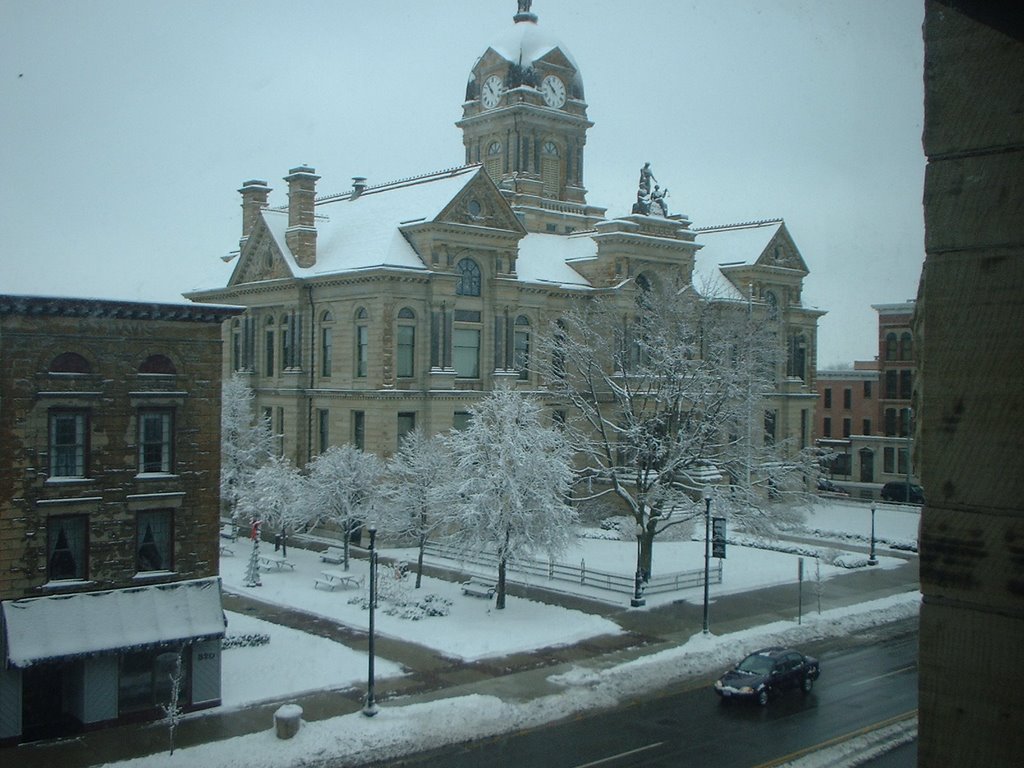
This picture was taken through my apartment window last year. This year? In the 50s.
3.07.2006
Flik'r Slideshows

Almost done with reframing my startup article.
In the meantime,I just wanted to mention how cool the Flik'r slideshows are. If you get a chance to see this slideshow, it's probably worth the two minutes it takes to see it. Chantal Foster, the main editor at "Duke City Fix" cityblog took an urban hike--covering 12 miles in 8 hours. She took pictures of whatever she thought was interesting (mostly back alley stuff). She walked from approximately where I used to live to the downtown and back. I used to ride my bike down the main streets (definitely the gentrified and more neatly-coiffed side of things), but I still used to see these rougher edges peeking out. There are two really great things about Flik'r slideshows in general, and this one in particular.
1.) These pics give you a sense of movement that mirrors a journey through space. Stories manifesting in time, space, and affect. I am not doing much work in this area (and I know several of you readers are), but I find it really useful to make visible the pleasure and commonality of this kind of work. The analysis is much tougher, but I think it is useful to demonstrate just how human and useful our objects/subjects of study can be. This stuff is important enough to study, not because it is so alien, but precisely because the surprise is so central to what we do as humans.
2.) I love the juxtapositions that these kinds of rhetorics enable. Having a guy working on an old farm truck in front of his obviously-expensive townhouse, or having an F-150 sticking out of the garage of a lime-green live-work loft apartment is rich with meaning that might take pages to describe. Long textual exposition is certainly possible (and often wonderful), but I like the small bites that these kinds of slideshows enable. Sort of like theoretical tapas.
3.06.2006
Can't believe it's been almost two weeks

I've been trying to get several articles out the door and to re-tool an article abstract for a special issue (yes, Clay, I'll be submitting it later this week).
Lots of things going through my head, but most of them (ironically) tie up with my thoughts about semiotics and embodiment. Just a short list of some of these thoughts.
Lots of things going through my head, but most of them (ironically) tie up with my thoughts about semiotics and embodiment. Just a short list of some of these thoughts.
- if theory rises up from embodied particulars (Hayles discusses this in regards to AI and AL projects via three waves of cybernetics), then how do we "bust out" of these blurs of semsation? I know that psychoanalysis and Kantian categories are attempts to stabilize these processes into categories, but I'm suspicious of stable categories for what is supposed to be particular and fleeting.
- I am struggling with Signature/Event/Context implications. Speech acts like "I pronounce you man and wife" perform that which they describe, and are often used as examples. Still, I'm suspicious because these example seem to be the textual equivalent of a ringer (a professional disguised as an amateur--like when my intramural basketball team recruited Deb Hawhee for her placid and pleasent exterior hiding her Pat Summitt-trained lethal posting, 'bounding, and shooting skills). I like Michael Berube's example of the Stop sign from his essay in Trotsky and Wild Orchids, but it still doesn't get me all the way to more ephemeral communication (the memo, phatic communication, etc.)
- Collin Brooke has roped me in to Battlestar Galactica (perfectly timed for me to discuss Hayles notion of the posthuman in the graduate seminar I'm teaching). I love the show, and it performs many of the tensions we are reading and discussing in Hayles book (Cylons who are, for all practical purposes, human--as proxy for not only technophobic/technotopic thoughts, but also for fear of the "Other" in terrorism, etc.). My question has to do with the arc of the show. I see the original tensions bleeding into more Space Opera conventions. While the realist film conventions (partial view of spaceships, lens flares, near-silent space, documentary handheld camera shots, a bridge without a giant viewscreen or Captain's Chair, etc.) initially disciplined audience interpretation, the longer these shows stay on the air, the more likely they are to "jump the shark." The material networks that initially tolerate these projects eventually colonize them. The networks of relationships (advertising, semiotic conventions, constituted fans, etc.) persist and are changed, but I wonder how long early story arcs and styles can hold before the centripital forces make the material heterogeneities obvious.
- Working Blue notes Octavia Butler's passing. Butler's work Dawn was the first book that really made me feel the impact of slavery. That is saying a lot, considering I grew up on the Rez and did my undergraduate honors project on Toni Morrison and signifyin'.
2.20.2006
Eating Route 66
FYI foodies (and the food-blogging floggers), a couple of repatriated Duke City Bloggers have made a New Year's resolution to eat at EVERY restaurant on Route 66 in Albuquerque. To this end, the two posters (Eckelberg and Grumblecake) have tied in Google's mapping function to their individual reviews on their Travel Flog. Pure genius.
2.16.2006
Actual Textbook Title
Strategic Corporate Social Responsibility (William Werther Jr. and David Chandler).
Anyone else spot the problem with that title?
Anyone else spot the problem with that title?
2.09.2006
Maverick Cograts

Congratulations to South African "Twiggy" Baker for the upset win at the 2006 Mavericks Big Wave Surf Contest. There were a lot of 40-footers and the 6-8 wave sets were pretty tight and dangerous (naturally!).
If you want to see it on TV, NBC will broadcast it on May 13.
There are a few decent writeups on the contest, if you look around.
2.02.2006
Curling as Political Protest
If you want to help Washington D.C. get representation with their taxation, you can go to the DC Olympic Curling Team page to either:
A. Vault them into Olympic stardom, or
B. Help DC get voting representation.
Hats off to these folks for making their point with humor and panache (at least to the Quebecois, eh?).
A. Vault them into Olympic stardom, or
B. Help DC get voting representation.
Hats off to these folks for making their point with humor and panache (at least to the Quebecois, eh?).
1.26.2006
"Breathing"
So, I'm surfin' through my blogroll, and I see that Jenny is taking up yoga. She mentions that taking yoga has made her realize "how little (she) breathe(s)." I can totally identify with that, as success in a speedy world encourages non-contemplation of bodily things like chewing and breathing. Oddly, even though I have been lifting weights since high school football, I never really applied what I learned about breathing technique to my quotidian awareness (not, I'm not a no-neck guy...I played defensive back [mostly safety, which means I am the fastest person at running backwards]). My *secret* admiration of Dr. Weil didn't snap me out of this unawareness. It wasn't until my partner convinced me to take ballet that I began to *really* pay attention to this common and repeated activity. I think it probably started with trying to hide the fact that I am *always* the most unflexible person in any given ballet class. Breathing definitely helps with schootching a micron closer to your toes or knees (or to at least breaking a 90 degree angle). This daily ritual of breathing was only reinforced with music and the heuristics that dance teachers use to align posture (making the figure 8 through your spine and head, etc.). These are some of the reason I love seeing people like Deb Hawhee, Blake Scott, and Byron Hawk taking on the rhetorical situation of bodies...
1.20.2006
"Radical" Copyright
So far, all of the publicity surrounding the UCLA metaphorical fisticuffs has been pretty predicatable (you know...the story about the pencilneck ideologue offering students $50-$100 to record lectures and take notes from the evil faculty indoctrinators [cue orchestral violin swell in minor key]). The most interesting development I have read was UCLA's response to the pureile and ineffective jihad against Academic Freedom. At the very end of a predictable CNN writeup about the fight (written pretty much as a "right-vs-left" horserace) is an interesting sentence.
*snip*
UCLA spokesman Phil Hampton said the university planned to send Jones a letter warning him that faculty hold copyrights to all their course materials and that his campaign encouraged students to violate school policy.
*end snip*
I'm not sure how most universities handle faculty lectures, but I haven't seen this copyright angle used (at least publicly, John Logie?). It might be interesting to see intellectual property law hitch its wagon to academic freedom. After all, Universities are finding the commons model more difficult to articulate to state politicians looking to slash taxes and win elections. The "it's good for the state" model curries less and less favor, so it might make sense to see what comes out of the mouth of teachers as a type of owned property (and therefore off-limits to those who would treat utterances as public property and therefore actionable in the public sphere). It probably opens a can of worms, but I'm not sure this idea is all that bad.
Chomsky is right--you need to read the end a news story to find out what is REALLY important.
*snip*
UCLA spokesman Phil Hampton said the university planned to send Jones a letter warning him that faculty hold copyrights to all their course materials and that his campaign encouraged students to violate school policy.
*end snip*
I'm not sure how most universities handle faculty lectures, but I haven't seen this copyright angle used (at least publicly, John Logie?). It might be interesting to see intellectual property law hitch its wagon to academic freedom. After all, Universities are finding the commons model more difficult to articulate to state politicians looking to slash taxes and win elections. The "it's good for the state" model curries less and less favor, so it might make sense to see what comes out of the mouth of teachers as a type of owned property (and therefore off-limits to those who would treat utterances as public property and therefore actionable in the public sphere). It probably opens a can of worms, but I'm not sure this idea is all that bad.
Chomsky is right--you need to read the end a news story to find out what is REALLY important.
1.10.2006
JDJE rules the datacloud
I have bookmarked about a half-dozen of Johndan's Datacloud posts. I give up trying to compete with a snow-bound tech comm genius. Just go over there and see some of the cool odds and ends he has unearthed. I especially recommend the 2006 annotated workspaces. It goes well with the fish AND the polenta...
1.09.2006
When Blogs Attack

I'm a pretty big fan of Chuck Olson's Minnesota Stories video podcast, partially because of how raw some of these podcast videos can be. Their Christmas podcast consisted of three guys smashing up a television and a turntable with almost zero editing (you could hear mostly just Mike Judge'esque "heh heh"ing as the only soundtrack to this Dionysian violence). The podcasts of Ethiopians surreally protesting outside of a suburban Barnes and Noble, a review of a coffeeshop in early evening, and creative lawn snowboarding all make this a really interesting blog/podcast experience. Still, the recent "WCCO Radio" episode ended by the host Chuck Olson videotaping a driver from a hotel cursing him out and spitting at his car because Chuck cut him off. Chuck remarks
"What he probably doesn't realize is that I have a high-definition camera, and that I can call...and get his @$$ fired for spitting at me, so that's exactly what I am going to do. I love video blogging."
I'm still a fan and get a bit of a thrill watching Chuck (possibly) enact some retribution for someone else's road rage, but I still have to say that I'm not sure this should have been on a video blog for public consumption. I know that "Reality" TV packages and sells exactly these cinema verite (sorry about the accents, francophiles) moments, but I'm not as gung-ho about throwing this kind of edited read meat out for public consumption when the production company is essentially an army of one. After all, who do you blame for the "crassness" of documenting and publicizing others petty weaknesses. Not even sure I should be commenting about this...
1.08.2006
Long Run
5 miles in 48 minutes. Ran past the George House Coffeeshop, past the "Crazy Church" and halfway to the DOW plant.
It was in the 40s and sunny. In January.
All I wore was a light windbreaker and warmup pants. No gloves necessary.
It was in the 40s and sunny. In January.
All I wore was a light windbreaker and warmup pants. No gloves necessary.
1.07.2006
Posthuman Writing
Discovered a very cool project that demonstrates, in my estimation, a good posthuman sense of purpose. The "Alley Garden Project" website has this description:
*snip*
Our team has a plan to retrofit Albuquerque with the community-initiated green space it needs. A pilot project has already begun, and will continue into the summer, to demonstrate the potential of the idea. Our partnership will introduce community gardens into an unlikely but abundant space throughout the city--Albuquerque's alleys. We hope that these Alley Gardens will expand throughout our urban environment. The project will transform alleys into beautiful and productive spaces, nourishing our city by beautification and community investment. The Alley Gardens project will also enhance our city in many other ways: by empowering neighborhoods, and localizing food sources; by acknowledging our limitations with rainwater harvesting, and by reanalysis of our community's needs, we can raise the quality of life we experience in our city.
*snip*
I like the use of the phrase "quality of life." It situates improvement within limitation. It counters some of the larger development usurpation of the "quality of life" mantras. Usually, this means divorcing oneself from the immediate ecology/environment through the use of generica (whatever cultural amenities are in vogue, including big boxes and restaurants) and then creating some sort of "retreat" (either through a McMansion with a "great room" and vaulted ceilings or some other nondescript collection of spatial significations of wealth). "Quality" here means getting to the alleys with broken glass, etc. and meeting the folks around and even trying to see what kind of stuff survives in "this weather."
What is doubly interesting to me is how this group has gotten the word out through press releases, grant applications, and even the aforementioned website. This is the kind of writing I expect my students to do and the kind of writing they can expect training for in their classes. Situating bodies, acknowledging contexts, and advocating for users in an unpredictable ecology.
*snip*
Our team has a plan to retrofit Albuquerque with the community-initiated green space it needs. A pilot project has already begun, and will continue into the summer, to demonstrate the potential of the idea. Our partnership will introduce community gardens into an unlikely but abundant space throughout the city--Albuquerque's alleys. We hope that these Alley Gardens will expand throughout our urban environment. The project will transform alleys into beautiful and productive spaces, nourishing our city by beautification and community investment. The Alley Gardens project will also enhance our city in many other ways: by empowering neighborhoods, and localizing food sources; by acknowledging our limitations with rainwater harvesting, and by reanalysis of our community's needs, we can raise the quality of life we experience in our city.
*snip*
I like the use of the phrase "quality of life." It situates improvement within limitation. It counters some of the larger development usurpation of the "quality of life" mantras. Usually, this means divorcing oneself from the immediate ecology/environment through the use of generica (whatever cultural amenities are in vogue, including big boxes and restaurants) and then creating some sort of "retreat" (either through a McMansion with a "great room" and vaulted ceilings or some other nondescript collection of spatial significations of wealth). "Quality" here means getting to the alleys with broken glass, etc. and meeting the folks around and even trying to see what kind of stuff survives in "this weather."
What is doubly interesting to me is how this group has gotten the word out through press releases, grant applications, and even the aforementioned website. This is the kind of writing I expect my students to do and the kind of writing they can expect training for in their classes. Situating bodies, acknowledging contexts, and advocating for users in an unpredictable ecology.
1.05.2006
Missing One of the Points
I am not a breathless proponent of the "wisdom of the masses" meme (the "mean meme"? And, yes, I am aware that I have a Freakonomics link--those guys actually mine the data instead of trusting in it's "wisdom"). Still, I think that Jonathon Keat's Wired article "File This Under Data Overload" not only misses the point of digitization, but, because of the human-interest angle, misses one of the purposes of an archive.
*snip*
Of course, no matter how the system evolves between now and 2011, one module it won't encompass is Mr. Taylor. While Lockheed's design prototype emphasizes intuitive access for users ranging from amateur genealogists to career paper pushers, no software on the market today or in the future is likely to have the veteran archivist's idiosyncratic expertise, his intuitive grasp of the collection's contents.
*snip*
I am a HUGE fan of archivists, but digitizing these materials will enable an entire range of archivists to apply their own expertise to these archives. Limiting close scrutiny to meatspace shuts out an endless amount of possible experts from inhabiting the archives. There is nothing preventing institutions from hiring people who are digital archives experts. Harvard could hire one. UT Austin could hire one. I suspect that there will be amateur archivists who become experts in negotiating this mass of data. The interconnectivity could enable people to create new knowledge networks as well as interface filters that enable all sorts of Vannavarian pathways through this huge archive.
*snip*
Of course, no matter how the system evolves between now and 2011, one module it won't encompass is Mr. Taylor. While Lockheed's design prototype emphasizes intuitive access for users ranging from amateur genealogists to career paper pushers, no software on the market today or in the future is likely to have the veteran archivist's idiosyncratic expertise, his intuitive grasp of the collection's contents.
*snip*
I am a HUGE fan of archivists, but digitizing these materials will enable an entire range of archivists to apply their own expertise to these archives. Limiting close scrutiny to meatspace shuts out an endless amount of possible experts from inhabiting the archives. There is nothing preventing institutions from hiring people who are digital archives experts. Harvard could hire one. UT Austin could hire one. I suspect that there will be amateur archivists who become experts in negotiating this mass of data. The interconnectivity could enable people to create new knowledge networks as well as interface filters that enable all sorts of Vannavarian pathways through this huge archive.
1.03.2006
Welcome to the "Blogos"phere
Professor Hawhee just started a new blog. She studies rhetoric and is an expert on rhetoric and the body. This is not surprising to me, since when I was at Penn State, I tried my best to rope her into playing for my intramural basketball team (she was a year behind me when I was an M.A. student). You see, she played Tennessee basketball for HOF coach Pat Summitt. I needed to know little else, but got a chance to mix it up with her (along with much of the Philosophy department and my roomie Dr. Grass) in pickup basketball games. Although I was totally bummed when she didn't join the team (she did so the next year AFTER I had left for another Ph.D program), I knew that she would go far if she studied as hard as she played.
In short, give her blog a read. In long, give all of her scholarship a read. It's that good.
In short, give her blog a read. In long, give all of her scholarship a read. It's that good.
1.02.2006
Day After the Marine Corps Marathon

Sport and I stretching the day after the Marine Corps Marathon. No, this photo was not staged. M-dawg or D-dawg (our running buddies and fellow foodies) took this photo as we were waiting for the bus at the Postal Museum in D.C. This marathon was VERY painful, but the next day was much more pleasant than the New York City Marathon aftermath. Having to do the "backwards crab" down subway stairs is NOT my idea of celebrating the accomplishment.
4.5 miles
Ran 4.5 miles in 45 minutes (yes, I run most training runs at 10-minute mile pace). The weather is pretty darn warm (45 and overcast), so I didn't wear gloves and had to take off my windbreaker about halfway through.
I'm going to eat my greens, beans, and cornbread tonight (that isn't bad luck, is it?).
I'm going to eat my greens, beans, and cornbread tonight (that isn't bad luck, is it?).
Subscribe to:
Posts (Atom)