For those of you unfamiliar with my work, Eclipse is one of the companies I have been studying. They may have just won the race to the starting line (!) for the Very Light Jet market. Unsurprisingly, the announcement was made at an airshow:
Complete article here
FAA clearing the way for mini jets
WASHINGTON (AP) -- A new light, cheap and fast jet is expected to be certified for flight Thursday.
Eclipse Aviation's E500 will be the first "very light jet," or VLJ, to receive a provisional certification by the Federal Aviation Administration. Thousands more are expected to take wing over the next decade.
The announcement, at the annual AirVenture air show in Oshkosh, Wisconsin, is one of the biggest things to happen to general aviation in years. Acting Transportation Secretary Maria Cino traveled to the show to make the announcement....
The big question surrounding VLJs is who will use them and where they will fly.
Vern Raburn, the founder of Albuquerque-based Eclipse Aviation Corp., predicts VLJs will be used as air taxis: for-hire limousines-with-wings that will take off and land at thousands of small airports. Businesspeople, he says, will be attracted to them because they will get where they need to go faster and with less hassle than on a commercial flight -- and cheaper than on a chartered business jet.
VLJs can land on runways as short as 3,000 feet (900 meters), compared with the 4,000 (1,200 meters) or 5,000 feet (1,500 meters) required by the smallest jets now being flown. The FAA says there are more than 5,000 small, underused airports in the United States.
7.27.2006


7.25.2006
Spirit
Alex commented that:
I think you strike upon something important here in the notion of these bloggers as ghostly figures, both virtual and material (in the way Derrida remarks about the spectral). They haunt Rt. 66, visiting their haunts. And as you note in another post, it is their haunting (their frequent, periodic inhabitation) that establishes their ethos, their identities, both within the blogosphere and the "505."
I couldn't agree more. I wish I could take credit for this idea, but as you mention Derrida discusses this. A major influence on my thoughts is Steve Pile's book Real Cities. He does a nice job looking at the spectral (he uses the term phantasmagoria for its historical and performative connotations), AND does a nice job of connecting it with "on the ground" experience. I think this was what I am reaching for more generally in my own perspective (and one of the reasons I am looking at epideictic ethos, rather than, say deliberative, or forensic ethos. It's about those we share share space with, celebrate with, warn, etc. rather than just argumentation).
I also like the way that the Route 66 combines an abstract sense of movement and speed (something Baudrilled noted was key to understanding Americanness in this travelogue America) with the material realities of the automobile. Route 66 is celebrated (it is the most covered American song), and is famous for its nostalgia, but it was a BLOODY and dangerous road. There are probably more than a few ghosts, both happy and angry on this road.
7.24.2006
VR@RL starts today
My piece is over at Tech Toledo, a domain that was going to host the CityBlog that my second student charette team created (don't ask, go over there and explore). If you want to see what other new media-types are creating for the virtual conference, there should be are links at the conference front page soon.
Please feel free to leave a comment at Tech Toledo, as I'll be cross-posting about the project (here and) there all week.
Please feel free to leave a comment at Tech Toledo, as I'll be cross-posting about the project (here and) there all week.
7.17.2006
Sunday BakeBlogging
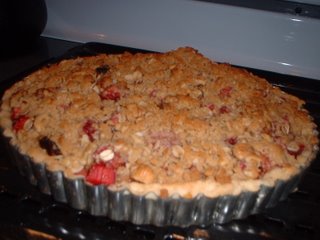
Sport and I made a strawberry and rhubarb tart (from Once Upon a Tart, using Shamie's crust), using rhubarb from the local Farmer's market.
We also spent our time making these two monsters:

We used the Cooking Light 2006 compilation for this recipe (and substituted zante currants for raisins). We hoped they would rise well, but LORDY!

We also spent our time making these two monsters:

We used the Cooking Light 2006 compilation for this recipe (and substituted zante currants for raisins). We hoped they would rise well, but LORDY!
7.15.2006
So last night...
Sport and a few friends of ours were walking back from the Fargo Street Fair (and some pretty woot desserts and Nicole's Fine Pasteries), when we walked by a building that usually has a bunch of older men sitting out front. Earlier, I had observed that this probably signified subsidized housing and that a lot of those guys were probably vets. Sport seemed a little surprised, at which point I ribbed her inability to ascertain veterans without their uniforms. When we walked by, I remarked that these men might also be disabled vets (my father is a disabled Korean War veteran, so "disabled vet" is a category I use fairly frequently, and with a great deal of respect). As we were all walking by and looking at the building and the men standing out front, I remarked (no lie) "there are the epaulet-less epileptic vets."
Say that three times fast.
Say that three times fast.
7.12.2006
Wednesday Fargoblogging
Been here for about a month (off and on), so I thought I might want to give you all a bit more of a glimpse of Fargo life than just the garden in front of my building. So...
Sport and I went to this place called The Red Raven Espresso Parlor. Yes this place is in a basement (hence the elevated signage).

It's the sort of establishment that definitely does NOT see many perfessers of my ilk frequenting the place. In fact, the only thing non-edgy about the Red Raven was me taking photos with my digital camera.
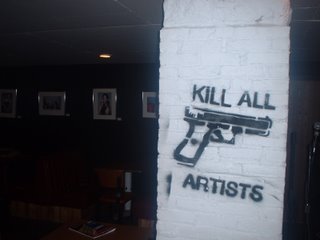
The cappuccino was pretty darn good (and the only place that I have ever been that has an 8 oz. serving outside of Italy [and the milk was properly steamed--not hot milk and not beaten egg whites]).

I definitely appreciate a coffee place that opens after noon and closes well after midnight (and is next door to a comix store to boot).
Sport and I went to this place called The Red Raven Espresso Parlor. Yes this place is in a basement (hence the elevated signage).

It's the sort of establishment that definitely does NOT see many perfessers of my ilk frequenting the place. In fact, the only thing non-edgy about the Red Raven was me taking photos with my digital camera.

The cappuccino was pretty darn good (and the only place that I have ever been that has an 8 oz. serving outside of Italy [and the milk was properly steamed--not hot milk and not beaten egg whites]).

I definitely appreciate a coffee place that opens after noon and closes well after midnight (and is next door to a comix store to boot).
7.09.2006
Long Run Today
After a breakfast of coffee and Moosewood puffy pancake (with carmelized apples and fresh blueberries), sport and I struck out for our long run.
Under overcast skies and 60 degree temperatures, we ran to downtown, south on Broadway, to the river, past the rapids, over the pontoon pedestrian bridge, into Moorhead, through the river neighborhood, to Concordia College...
and back. It was beautiful, even if we didn't like squeezing out the miles.
Next on the agenda:
Catch PHC
Make and freeze pizza dough
Cook big batch of ribolitta
7.08.2006
Blog On Demand
Last night, sport and I went with about half of my department to the local Red Hawks minor league baseball game (complete with midwestern "O Canada," "God Bless America," "Star Spangled Banner," AND musically-accompanied fireworks). After the extremely pleasant evening watching baseball players get ejected and random crowd members getting beaned with merchandise and baseballs, my colleague Marshall turns to me and asks "so, you're going to blog about this tommorow. Right?"
I don't blog on demand, my friend.
I don't blog on demand, my friend.
7.07.2006
Huzzah for my peeps
Glad to see my peeps getting together with government and industry to do what Martha Stewart might call "a good thing":
*snip*
Tech Project Builds Peace
By Charles D. Brunt
Journal Staff Writer
U.S. efforts to employ former Soviet Union weapons scientists in peaceful research projects is creating new technologies and products for worldwide markets, ranging from temperature-resistant batteries to robots that detect land mines.
Seven technologies and related products were on display Thursday at Sandia National Laboratories for Sen. Pete Domenici, R-N.M. He is chairman of a Senate subcommittee that helps secure funding for such projects through the Department of Energy.
The U.S. Industry Coalition, a nonprofit association of U.S. companies engaged in commercializing technologies developed with former Soviet weapons scientists, sponsored the event.
/*snip*
If you want to read the whole story, you'll have to sit through a short ad.
7.06.2006
Running
Sport and I ran our typical over-river route, but added an extension past the Broken Axe Metal Bar and stopped by Scan Design to see about getting a cheap bistro table for my office (I'm going deskless...how metro of me).
7.05.2006
Of Tornadoes
I don't know if Dr. Hawhee figured the ultimate significance of her tornado dreams, but I know some colleagues in Ohio who wish their recent brush with tornadoes was only a dream.
Sport's former colleagues at Ohio Northern University crowded into her old office (settling the debate of who has the worst, most subterranean office). One of my earlier "Friday Blog Teacher" awardees managed to keep teaching his summer class during the storm, even with faculty and the dean crowded in the tiny cubicle of a basement office. That may propel Dr. Scott to his second blogaward. He's definitely a finalist now.
Stay safe, residents of Tornado Alley.
7.03.2006
Back to the Grind
If there any of you "I want to be a professor so that I can get summers off" crowd out there, vacation is officially over (if you can call a 1,000 mile move followed by a week of fun and a week of grading over 1,000 Advanced Placement Rhetoric and Composition exams "vacation").
It's back to course prep and scholarship (and yes, this blog post counts as one of my "breaks").
Chop chop!
It's back to course prep and scholarship (and yes, this blog post counts as one of my "breaks").
Chop chop!
6.30.2006
Life is Good
People don't often count their blessings in public. Let me just describe three:
1. My morning run with sport over the Red River (and, believe it or not, through the "woods" of Island Park) was followed by a nice cappuccino at Babb's.
2. We found some nice spring onions at the downtown Fargo farmer's market yesterday.
and lest you believe that my only concerns are gastrointestinal
3. I have seen more beautiful and colorful thrushes here than in my entire stay in Ohio (although I'm still looking out for raptors!).
Hope you all get a chance to get outside and enjoy the summer.
6.27.2006
North Dakota

The view from my window looks like Yavin IV (geeky Star Wars reference: look it up if you must).
HOW cold does it get here in winter?
6.24.2006
Pay no attention to the gremlin on the wing

I'm home and just a little disturbed. During my 21 hour trip home from Florida, I was fortunate to hear a very loud "BANG" right outside my airline window. This jarring noise was followed by the magic words one longs to hear from your pilot:
"This is the captain. We seem to be experiencing engine failure."
Now we were reassured that we still had "ONE good engine," but the passengers were warned about the emergency vehicles and emergency positions one might need to assume SHOULD the flight attendants scream out "BRACE YOURSELVES" right at landing. Definitely soothing. Needless to say, we made it back safely (right back to the same gate, actually). We all took the same trek (with a different plane, we were assured).
Is Amtrak still running?
6.10.2006
Moments of Grace
Two moments of grace during vacation.
For sport: seeing the dolphins swimming by on her childhood beach.
For me: flying over Monument Valley at 33,000 feet and immediately recognizing the monoliths that watched over my childhood (especially "Old Man").
You can't go home, but sometimes home waves to you in the distance.
For sport: seeing the dolphins swimming by on her childhood beach.
For me: flying over Monument Valley at 33,000 feet and immediately recognizing the monoliths that watched over my childhood (especially "Old Man").
You can't go home, but sometimes home waves to you in the distance.
6.01.2006
Not-So-Secret Garden
 The herb garden in front of our new apartment. Pretty much the opposite of everything I previously thought about Fargo.
5.31.2006
Inside the Door
When sport and I got to our new abode, our box of summer reading was right inside the door:
Foucault's Pendulum (Umberto Eco--I'm a little past half done)
Cooking Light 2006 Recipes
Finnegan's Wake (duh)
The Human Stain (Philip Roth--finished)
A Thousand Plateaus (Deluze and Guttari)
Oh. Play That Thing (Roddy Doyle)
The Birth of the Clinic (Michel Foucault)
The Archaeology of Knowledge (Michel Foucault--O.K., so I have a Foucault theme here. I've already read this one)
Breakfast on Plut0 (Patrick McCabe)
Moosewood Restaurant Celebrates
The Space Planner
It's not much, but it should keep us distracted as we finish unpacking.
5.14.2006
The Long Goodbye

Most of you in the blogosphere don't know that sport (she's the the muddy one in the center--ruminate on whatever metaphor you like) and I will be taking our show to Fargo at North Dakota State University this Friday. We appreciate what our two institutions did for us, but the pull of working at the same institution, with graduate students, and within walking distance of the office (we can sell our second car--yay!), was just too tempting.
I'll get a chance to work with Kevin Brooks, Amy Rupier-Taggert, Betsy Birmingham, and Dale Sullivan (yes, THAT Dale Sullivan), and get to work in an arts-friendly place with a burgeoning downtown scene that has the still-rough edges that makes me feel at home.
To all of you who are STILL giving sport and I a mind-blowing victory lap (parties for pretty much two weeks straight): Thank You! It's incredibly gracious of two departments who invested as much as they have in us. Thank you truly.
Final (for now) thoughts on Crowley's Toward a Civil Discourse
A few more thoughts on Sharon Crowley's Toward a Civil Discourse:
1. This is an important text, if only for the reason that Stanley Fish is right. Rhetoricians NEED to engage in what is an ontological and epistemological battle (although I believe that the two sides that Crowley describes--the fundamentialist and the liberal--see this as two different battles. For the liberals it is always epistemological, and for fundamentalists, it's ontological). I appreciate what Dr. Crowley is opening herself up to in writing this.
2. In some ways, I think of this book in the same way I read and understand Leslie Marmon Silko's Almanac of the Dead. It reads a little like a fin-de-siecle border drama, a lot like a Jeremiad, with a type of mystical gesture towards hope. The inexorable march northward in Silko's text (a march of prophesy) is parallelled by Sharon's gesture towards invention that might bring two warring factions closer (an enraged fundamentalism and a reluctant liberalism).
3. In her latest post, Dr. Edbauer notices the difficulty of formulating this debate as one that might revolve the idea of the irredemable. I'm extremely hesitant to call it that because of #4.
4. One thing that struck me about Dr. Crowley's book was the threat that is sketched out in her narrative. She is correct in looking at the Apocalyptic nature of fundamentalist Christian rhetoric and the importance of delineating clear inside/outside binaries based mostly upon patriarchal structures (patriarchal structures maintained semiotically with pulpits, diases, and "big bibles" held aloft during long and stylized sermons. Structures maintained discursively with distorted Biblical emphases on direct descent [a bizarre Gentile practice when perceived outside of its patriarchal function], fetus-centrism, and "Old Testament" justice). What she misses in her threading together of the Left Behind narratives and a solid historicizing of the Apocalyptist movements is the syncretism of the congregations. When I attended the churches and bible-studies that popularized the texts that Dr. Crowley studies, most of my fellow attendees didn't actually live most of what they publicly attested to. It was a sort of salmon faith. Most of the folks I went there with wanted to swim with a particular school of fish, direct their feelings towards some sort of larger and coherent goal (getting to heaven), and maybe eventually return towards the spawning ground of actually living their faith when they, well, spawn. I was one of the few kids in these groups that took it seriously (the thin line between Saturday night and Sunday morning was more of an indictment of my boring Saturday nights than an indication that I went to church hung over). Did this sort of "preacher-kid syndrome" mean that my pentacostal/patriarchal/fundamentalist peeps didn't believe in this stuff. Kind of. We were embarassed by a lot of what Dr. Crowley delineates. There were even more bizarre parasites like exorcism call-in shows (the main guy, Bob Larsen, has had a re-surgence lately). We all pretty much rolled our eyes, but were too polite to confront our elders, who seemed pretty bewildered at modernity in general. We just sort of absorbed these beliefs and maintained pretty normal kid behavior. While there is a mental split between professing and living, it isn't all that unusual in nearly any belief system. My now-discarded fundamentalism has proven exceedingly useful when teaching freshman composition and rhetoric. Profess ideals and practice the real.
5. I especially agree with Jeff Rice's assertion that turning the fundamentalist rhetoric against itself seems a bit weak. I think that the strength of fundamentalist rhetoric is something that liberal rhetoric can appropriate successfully--that is, take language theorists seriously when using language. Meaning-making consists of both grouping and differentiation (differance). Fundamentalists can be deconstructed, but that misses the point of rhetoricians needing to craft appeals that reconfigure the "us" upon important differences. Yes, people will differentiate themselves, but take some sort of stand (and I think Crowley's book is doing this). Take Gerald Graff's "Teach the Conflict" approach one step farther. Get in there and believe in something. The writers of America's founding documents knew that Liberal Rhetoric could shape a country. They also knew that it could help keep us from killing one another. Our job isn't just one of co-optation of scary foundations (and, yes, Berube's antifoundational approach is itself a type of foundation that he defends more than adequately). A rhetor's job includes contending with and believing in all sorts of slippery and scary things like arete, phronesis, and even, gulp, agape.
Subscribe to:
Posts (Atom)