9.07.2006


9.06.2006
9.04.2006
Parlor, database, or....
Collin has a great post on the metaphor of Burke's parlor, and some of the nuances of championing this metaphor in front of graduate students (who generally need to publish to even be considered for a job). Burke's metaphor:
*snip*
Imagine that you enter a parlor. You come late. When you arrive, others have long preceded you, and they are engaged in a heated discussion, a discussion too heated for them to pause and tell you exactly what it is about. In fact, the discussion had already begun long before any of them got there, so that no one present is qualified to retrace for you all the steps that had gone before. You listen for a while, until you decide that you have caught the tenor of the argument; then you put in your oar. Someone answers; you answer him; another comes to your defense; another aligns himself against you, to either the embarrassment or gratification of your opponent, depending upon the quality of your ally's assistance. However, the discussion is interminable. The hour grows late, you must depart. And you do depart, with the discussion still vigorously in progress.
/*snip*
Nice, romantic metaphor (and redolent of a Viennese coffeehouse or Czech wine cellar). Collin problematizes the notion "writing" as "dipping oars" quite nicely:
*snip*
My concern is with the ease with which "putting in one's oar" is translated into the nominalism of "publication." As in, I need a publication, or to get a publication, or I don't have enough publications. I'm being somewhat specific here: I'm objecting to "publication" as a thing you have as opposed to "publishing" as an activity you engage in. And thus my concern is also with how we translate "listen for a while," because I think that's key for publishing (and perhaps less of an emphasis in publication).
/*snip*
Collin's point's to Jeff's djing (shades of Johndan Johnson-Eilola's chapter on turntablism in datacloud), and Brenden's katamari presentation at VR@RL as two examples of "collection." One thing I think worth further exploration that neither the Parlor, nor the database collection cover is virtuosity. Somewhere between the rhetorical canons of invention and collection, and the canons of style and delivery lies the ability of knowing what might belong where. The database (with it's connotations of nearly-unlimited memory) and the Parlor (with it's organicist emphasis upon the semi-intoxicated speaker as both collection and performer--a very Burkean bifurcation) push aside the question of how to cut and/or arrange. The mechanistic muscularity of the database and the gentility of the parlor conversation obscure some very real power relations that "dipping oars" and "collection" are attempting to subvert, or at least change. And lest you think I'm slipping into a mechanistic Marxist read of the situation as an easy way out, I am not. I think that Collin's corrective is a good one, but I also want to re-imagine the process as more agonistic and/or dramatistic. I think that the "listening" or "collecting" phases can be also read as "training" or "practicing" for a future performance that is to be evaluated. The slippage between semi-drunk BS grad-school bar conversations and Burke's parlor are a bit too easy. Seeing these conversations and collections as a pathway to virtuosity (certainly someone well-versed in turntablism would understand) could help salve some of the frustration of teachers who goad grad students to take their studies "seriously" by remaining mindful of the collection phase, rather than speeding straight to evaluation/argument (the cayenne "heat" that supposedly generates publication--the talented Mr. Ripley shows up at the Parlor?).
*snip*
Imagine that you enter a parlor. You come late. When you arrive, others have long preceded you, and they are engaged in a heated discussion, a discussion too heated for them to pause and tell you exactly what it is about. In fact, the discussion had already begun long before any of them got there, so that no one present is qualified to retrace for you all the steps that had gone before. You listen for a while, until you decide that you have caught the tenor of the argument; then you put in your oar. Someone answers; you answer him; another comes to your defense; another aligns himself against you, to either the embarrassment or gratification of your opponent, depending upon the quality of your ally's assistance. However, the discussion is interminable. The hour grows late, you must depart. And you do depart, with the discussion still vigorously in progress.
/*snip*
Nice, romantic metaphor (and redolent of a Viennese coffeehouse or Czech wine cellar). Collin problematizes the notion "writing" as "dipping oars" quite nicely:
*snip*
My concern is with the ease with which "putting in one's oar" is translated into the nominalism of "publication." As in, I need a publication, or to get a publication, or I don't have enough publications. I'm being somewhat specific here: I'm objecting to "publication" as a thing you have as opposed to "publishing" as an activity you engage in. And thus my concern is also with how we translate "listen for a while," because I think that's key for publishing (and perhaps less of an emphasis in publication).
/*snip*
Collin's point's to Jeff's djing (shades of Johndan Johnson-Eilola's chapter on turntablism in datacloud), and Brenden's katamari presentation at VR@RL as two examples of "collection." One thing I think worth further exploration that neither the Parlor, nor the database collection cover is virtuosity. Somewhere between the rhetorical canons of invention and collection, and the canons of style and delivery lies the ability of knowing what might belong where. The database (with it's connotations of nearly-unlimited memory) and the Parlor (with it's organicist emphasis upon the semi-intoxicated speaker as both collection and performer--a very Burkean bifurcation) push aside the question of how to cut and/or arrange. The mechanistic muscularity of the database and the gentility of the parlor conversation obscure some very real power relations that "dipping oars" and "collection" are attempting to subvert, or at least change. And lest you think I'm slipping into a mechanistic Marxist read of the situation as an easy way out, I am not. I think that Collin's corrective is a good one, but I also want to re-imagine the process as more agonistic and/or dramatistic. I think that the "listening" or "collecting" phases can be also read as "training" or "practicing" for a future performance that is to be evaluated. The slippage between semi-drunk BS grad-school bar conversations and Burke's parlor are a bit too easy. Seeing these conversations and collections as a pathway to virtuosity (certainly someone well-versed in turntablism would understand) could help salve some of the frustration of teachers who goad grad students to take their studies "seriously" by remaining mindful of the collection phase, rather than speeding straight to evaluation/argument (the cayenne "heat" that supposedly generates publication--the talented Mr. Ripley shows up at the Parlor?).
9.03.2006

Goodness
I loved the movie Finding Forrester (yes, even for some of its extremely problematic ways of dealing with race and class), but this is just too, too funny.
9.01.2006
8.31.2006
8.29.2006
Crisis in Publishing and Peer Review
Adam Rogers has a good article at Wired.com on the use of wikis and web communications to mod peer review. The author is a bit glib comparing the journal Nature to the physics and mathematics "prepublication paper" publication outlet (!?) arXiv (archive), Biology Direct, and PLoS ONE, but he does a pretty good job showing the future of peer review. If academics want to preserve peer-review (a mechanism that ensures professional status AND serves as a check to the corrupting influence of corporatist and government interest), then we should take a serious look at shifting to this version (we actually are doing this at journals like Computers and Composition Online and Kairos, although much of this has to do with using the visual and aural possibilities of the medium, rather than the structural and speed advantages of online communication). Much of the academic "crisis in publishing" has to do with a technological shell game that has now caught up with Libraries (causing inordinate price inflation for journals and books and forcing University Presses to close). While it is imperative for tenured faculty and administrators to recognize online venues as legitimate, it is even more important for us to separate issues of professional accreditation from technological issues. One of the biggest and most easily leveled arguments against peer-review (read: tenure), is the sheer expense of the process. In order for academics to scrupulously defend professional accreditation as a social good, we have to nullify this argument. Putting research online will also allow us to share more of our own work with those who may benefit from our work. So it may help solve the "crisis in publication" and the "crisis in de-professionalization" at the same time. Genius.
8.28.2006
Funny thing about snakes on a plane
I'm not afraid of snakes. I'm afraid of flying. As far as I'm concerned, this year's Blair Witch Project could have been called You. On a Plane.
8.27.2006
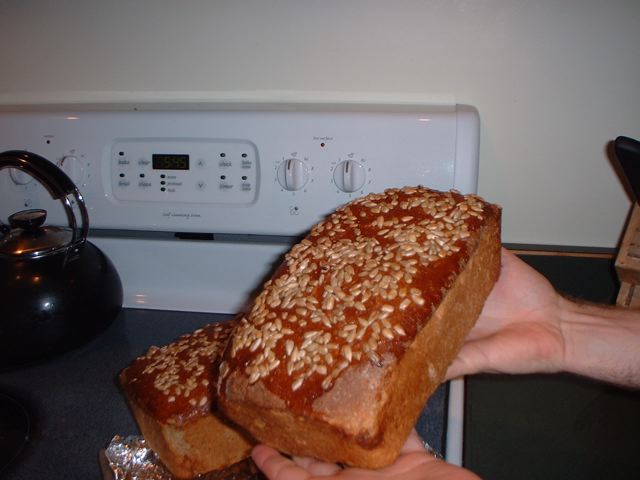
Sunday BakeBlogging
My hyper-mediating colleague Marshall wanted me to blog about the 5k "Run Through State U" on Saturday (in case you want to know, it was pretty uneventful, outside of the fact that the nice young woman who toured me around campus during my on-campus interview came up and re-introduced herself).
No dice, Marshall. Today I clear the deck to bring you these beautiful LOAVES O' LOVE. The recipe for these multi-multi grain loaves came from one of Sport's former colleagues (appropriately enough, a medievalist). They have cracked wheat, sunflower seeds, sesame seeds, all purpose flour, whole wheat flour (North Dakota stone ground, incidentally), wheat germ, yeast, a little shortening, water, honey, and molasses. Oh, and we used an egg and milk wash with sesame seeds on the outside. We've already had some of the bread with some local honey. Low carb is for the insane, my friends.
8.24.2006
Radar Obsession

I share an obsession with my colleague Marion Mahony. We both like to look at the weather online while we are sitting inside. There is something so satisfying about watching the colored spray of doppler rader exploding across a map of your town. Marion likens it to the sublime.
Yes, we also both love the Weather Channel.
8.22.2006
Kewl Mapping Tool
If you are a runner like I am (or, a much better runner), you know that finding distances on running courses can be tough.
Web2.0 to the rescue, my friends. The U.S. Track and Field website has a mapping function where you can map and store your particular running route with a wicked kewl mapping tool (vraiment easy to use). You can store your own routes and even look up stored routes and plan new running routes in cities you plan to visit.
The only drawback? You can't lie to yourself about your distance or pace. My regular run is about 1/2 mile shorter than I had thought.
8.19.2006
Great Tech Comm Website
Instructables is a great resource for showing students technical communication as a calling.
My favorite? Instructions on how to make five foot tall Jacob's Ladder.
My favorite? Instructions on how to make five foot tall Jacob's Ladder.
8.15.2006
Minneapolis To Do List
Buy gift at Mall of America for cousin's 10 year birthday: check
Swank tapas at Solera: check
Run around Lake of the Isles: check
Brunch at French Meadow Bakery: check
Testing the strength of the cantilever forming the Guthrie's new "endless bridge": check
I just knew I should have put finishing my syllabus on that list.
Swank tapas at Solera: check
Run around Lake of the Isles: check
Brunch at French Meadow Bakery: check
Testing the strength of the cantilever forming the Guthrie's new "endless bridge": check
I just knew I should have put finishing my syllabus on that list.
8.10.2006


8.09.2006
Omission
I thought I had Collin Vs. Blog on my blogroll (I read his posts at least once or twice a week).
Problem rectified (!).
Problem rectified (!).
8.08.2006
Nets and Jets
Bruce Sterling has a deep-thinking post at Wired today. Chris reports on Chris Parry's speech at the Royal United Service Institute--the oldest military think tank in the world. In the speech, rear admiral Perry reports on some of the counterintuitive results of neoliberal policies--cheap airfare and ubiquitious/easy communication.
*snip*
The technological drivers of globalization have enabled stateless barbarians to seize the initiative. You can’t keep them out by blocking the border, and the harder you smash the failed states that nurture them, the more they thrive. At the first sign of weakness, these new-wave Vandals will log on to urge their diasporic compatriots to attack you on your own soil. Failing that, they’ll hop on the next flight, pick up their baggage, and sidle into Starbucks to download the latest instructions from Abu Ayyub al Masri...Nets and jets are never a one-way street, and even Parry’s reverse colonization can reverse itself. Consider Somalia, which, for 15 years, has been a running sore of new world disorder. Jets have evacuated everyone who could buy a ticket and have flown in battalions of jihadists. As for nets, this lawless maelstrom is one of the most heavily wired regions of Africa; free of licensing, taxes, and state-owned monopolies, entrepreneurs have been building out cell capacity and Net nodes like Silicon Valley whiz kids. To complicate matters, counter-terrorist warlords said to be financed by the US recently lost the country to a loose association of Islamic militias. This makes Somalia a prime case study for the darkest nets-and-jets forecast.
*/snip*
I'm not sure I totally buy Mr. Sterling's silver lining of hope that neoliberal economic and political policies and neoconservative military enforcement of neoliberal policies can get ahead of technologically-enabled smart mobs. Still, I really hope he is right.
7.30.2006
Syncretism in action
In an earlier post about Dr. Sharon Crowley's book, Toward a Civil Discourse, I pointed to the the religious syncretism I witnessed during earlier evangelical Christian experiences. The New York Times has a nice story today documenting how Rev. Gregory A. Boyd in St. Paul, Minnesota embodies this syncretism. Conservative by most measures of the word, Reverend Boyd is radically separating Apocalyptsm from his congregation's evangelical practices:
*snip*
Before the last presidential election, he preached six sermons called “The Cross and the Sword” in which he said the church should steer clear of politics, give up moralizing on sexual issues, stop claiming the United States as a “Christian nation” and stop glorifying American military campaigns.
“When the church wins the culture wars, it inevitably loses,” Mr. Boyd preached. “When it conquers the world, it becomes the world. When you put your trust in the sword, you lose the cross.”
Mr. Boyd says he is no liberal.
*/snip*
Perhaps this is a version of the invention Dr. Crowley calls for. I saw this (and participated in this) this kind of religious invention throughout my spiritual life (I still do, to a certain extent). Looking for these kinds of articulations in the everchanging streams of politics, thought, and religion will, I think, provide those interested in building bridges a few more places to build. Heraclitus was right.
7.28.2006
Why do we meet at conferences?
My experience as part of the VR@RL has been somewhat diffuse. There has been a bit of a cool vibe, but mostly I have felt a bit detached from the proceedings. This could be partly because of the false start that occurred when the meatspace winter conference was cancelled, and probably has something to do with the fact that many of us are making the transition from vacation to "oh-my-goodness-I-need-to-finish-prepping-my-scholarship/classes."
Still, I feel a little detached from these proceedings. It is a little TOO easy to catch glimpses here and there and go right back to my own course/scholarship prepping. Meatspace synchronous conferences isolate you and then force you to dress up and try to act cool on the off chance that you might make a lasting impression on SOMEBODY. I think these social events are mostly good for us. English folks are notoriously introverted, and it is good to air us out in public spaces near restaurants and bars that require some sort of dressing up.
Of course, Alex and Alex helped us out by filming themselves in their presentations (and even putting pretty cool soundtracks together). Maybe next year's call should include the requirement of some sort of avatar and cool music. Just sayin...
Subscribe to:
Posts (Atom)