4.15.2011

Hawaii 2011 (Day Seven)

There are some things about Hawaii that are just a little bit different than other places. Breakfast seems a particularly interesting intersection of urbane, mundane, and funky. On the second day on the North Shore, we decided to get away from our tea-house/waffle palace preferences. Instead, we decided to try something a little different with our Starbucks coffee (how different can we get, really?). A bowl of acai sorbet with bananas, granola, honey, and frozen blueberries/raspberries/blackberrie was maybe one of the best things we bought on this side of the island.


A little less successful was the Shark’s Cove Grill veggie scrambler. Great concept, but a Velveeta execution.


One of the pleasures of the morning was getting to sit across the street from Three Tables and Shark's Cove, watching them being absolutely pummeled by huge swells, and realizing that we avoided getting crushed by these waves by a mere few hours. Thank you again, LK, for letting us know these monsters were on their way.


Of course, these waves were really only a fancy invitation for the surfers to wax their boards and get out in the water. Despite the pull of our singularly-important morning hike at Ka'ena Point, the surfers hitting the large waves in Waimea Bay were too much to resist. There was a huge crowd at the beach, and it was just amazing to watch these surfers drop in on these huge waves in groups of 3, 4, and even 5 people.


By the time we got to to paking lot for the Ka'ena Point hike, the sun was getting pretty high in the sky. What I thought would be an easy hour-long hike turned out to take more like three hours.


I wanted to turn back petty often, but the azure color of the waves (and even the foam) against the backdrop of the lava rocks, the beach, and the succulent plants was just too mesmerizing to us. We pushed on.


At moments, when we peered over the edge of the rocks, it seemed like it would be pure bliss to just jump in. It was only in our imaginations did this plunge into the turquoise bath actually take place.


Although these waves were huge--we could feel them hitting the beach through the vibrations conducted through the sand--pictures don't usually do justice to their scale.


When we got to Ka'ena point, we thought our only reward was seeing predator traps (to protect the albatross nests), and to see the Coast Guard practicing their high-wind maneuvers.


Upon a little closer inspection, however, we realized that we happened upon two rare Hawaiian monk seals.


It took a few seconds to see these sleeping beauties. We would have kept even more distance had we been able to more clearly distinguish them from their background.


After our brush with these wonderful creatures (and our decision to invite sun stroke), we took a leisurely drive back down the Kamehameha highway to find Giovanni's famous shrimp truck.


Regardless of your dinner choice, your lunch requires a flotilla of napkins and/or wet wipes (personally, I'm a big fan of wet wipes).


We stuck with the garlic shrimp, and did not regret the decision thankyouverymuch.


A day at the shore wouldn't be complete without a sunset on the patio. Good night sun. Good night dolphin statues.


Of course, a few tropical drinks complete the picture. Good night Piña Colada. Good night Blue Hawaiian.

3.29.2011

Doc Mara's Media Materiality Manifesto

Change is inevitable, and best handled by many hands, feet, eyes, heads, and hearts.

Because communication mediation is inevitable, we should seek to build transparency, malleability, customizability, and human possibility into each medium.

To do this, media producers/authors/hackers/grokkers must:

1. Build in affordances.
2. Create affordances that offer the fullest range of individual change.
3. Reveal the limitations of the medium.
4. Build in possibilities to exceed limitations.
5. Invite participation through semantic, syntagmatic, paradigmatic, and tropic alignment and misalignment.
5. Identify and isolate cultural values the medium favors.
6. Build in the ability to toggle size, function, and pace of medium input and output.
7. Identify limitations as such.
8. Invite stability through participation instead of building stability as a de facto valuation of particular cultural forms.
9. Offer different levels of contexualization in artifacts.
10. Allow the widest range of juxtaposition possible.
11. Create the possibility, but not inevitability, of repetition.
12. Allow for a range of representations that could include a range of styles.
13. Invite contemplation of embodied consequences of medium use and production.
14. Avoid foreclosure of signification possibilities.
15. Eschew naturalization of inherently social participation.

Distributed changeability in media = Sustainable materiality

3.28.2011

Hawaii 2011 (Day Six)

When I'm traveling, it usually takes about a week for my documentation plan to unravel, and this vacation just reinforced the pattern. Our journey across the belt buckle of Oahu to the North Shore (or, as I mistakenly called it one day, "North Beach"), started to relax my photography ninja reflexes, and let me see some of the smaller details of island living.

To get us to the north side of the island and well past the tourist-trapping sugar enticements of the Dole Plantation, LK decided that we needed fuel for the journey. More soyrizo and eggs, as well as the remainder of what I think was quite possibly the largest avocado I have ever seen.
This breakfast was, as usual, delicious, but we still decided to stop in for a pineapple/frozen yogurt sundae.

When we got to the North Shore, I expected both more grandeur and more luxury. Instead, we were treated to some of the more laid-back aspects of Hawaiian life. Our hostel/cabin had resident pigs as well as walking alarm clocks.

To be perfectly honest, Miriam and I were kind of spooked when we pulled into our hostel. Maybe it was the electric-white sheen of Fargoans, but people seemed to stare at us wherever we walked.
I imagine that we are kind of strange looking to the tanned North Shore regulars, so there's that; however, we've probably picked up a bit of the midwestern fish-out-of-water-in-paradise vibe. Once we got settled in and stopped returning stares with every semi-stoned and half-naked island visitor (most had foreign accents), all felt fine.

One of the biggest disappointments of the vacation was the short amount of time we got to snorkel. Even though we rented some pretty sweet gear at Snorkel Bob's for a week, we only had about a two-hour window to get into the water. While we were enjoying our pineapple/yogurt sundae at the aforementioned Dole Plantation ("Hawaii's complete pineapple experience!"), LK texted us that 30-foot waves were on their way. We were not amused, as our destination, Shark's cove, is notoriously dangerous to snorkel in during the winter. 30-foot swells certainly didn't fuel our hopes that we would get into the water.

The mural on our wall did NOT reassure us, but we took our gear across the street and looked for a place to snorkel.
Fortunately for us, Pupukea beach has one sheltered spot where we could get in. We saw needlefish, a whole range of common Hawaiian reef fish, and even a Moray eel. Never. Lose. Hope.

Our cabin, while rustic, seemed to reinforce our urge for risk-taking.
Luckily, we got out before the waves got too big to brave.

What these waves took away with their power, they gave back in beauty. Seeing the wind peel off the wisps of surf wash from the crests of breakers was completely mesmerizing.

Waimea Bay, just a short 5-minute walk down the beach, gave us a chance to see some sunset surfing (and to get some of the saltwater our of our ears and other assorted places).

Once we finally settled in our cabin for the night, we could feel the waves pounding the lava shore just across the street.

Our informal wine glasses, ESPECIALLY my Tigger cup, seemed to underline the informality and the energy of the place we now found ourselves. It didn't matter that we hadn't taken pictures of everything--the waves, people, and even chickens were starting to truly transport us away from memories of snow and work.

3.25.2011

Hawaii 2011 (Day Five)

As my childhood guru used to say, Sunday's fun day, and this Sunday was no exception. In order to prepare for the difficult hike, LK made us breakfast of soyrizo and eggs (I THINK this memory is correct--our "host with the most," LK reminded me that my last breakfast was not the homemade granola, but rather fantastic chocolate croissants that 'Ito picked up for us before he joined us at the sunset picnic). After some coffee and eats, 'Ito, took us up to the Kolowalu trailhead and we were off!

I was thrilled, if a bit nervous about trekking up the side of a dormant volcano covered in red mud and all sorts of creeping vine-like things. I hope my hesitation didn't show TOO much.


Other than the slightly "Raiders of the Lost Ark" feel to this initial ascent, it was a perfect way to get a good view of Honolulu and the surrounding ridges (on a side note, I'm not entirely sure that even this height would have saved us from the future Hawaiian tsunami of doom).


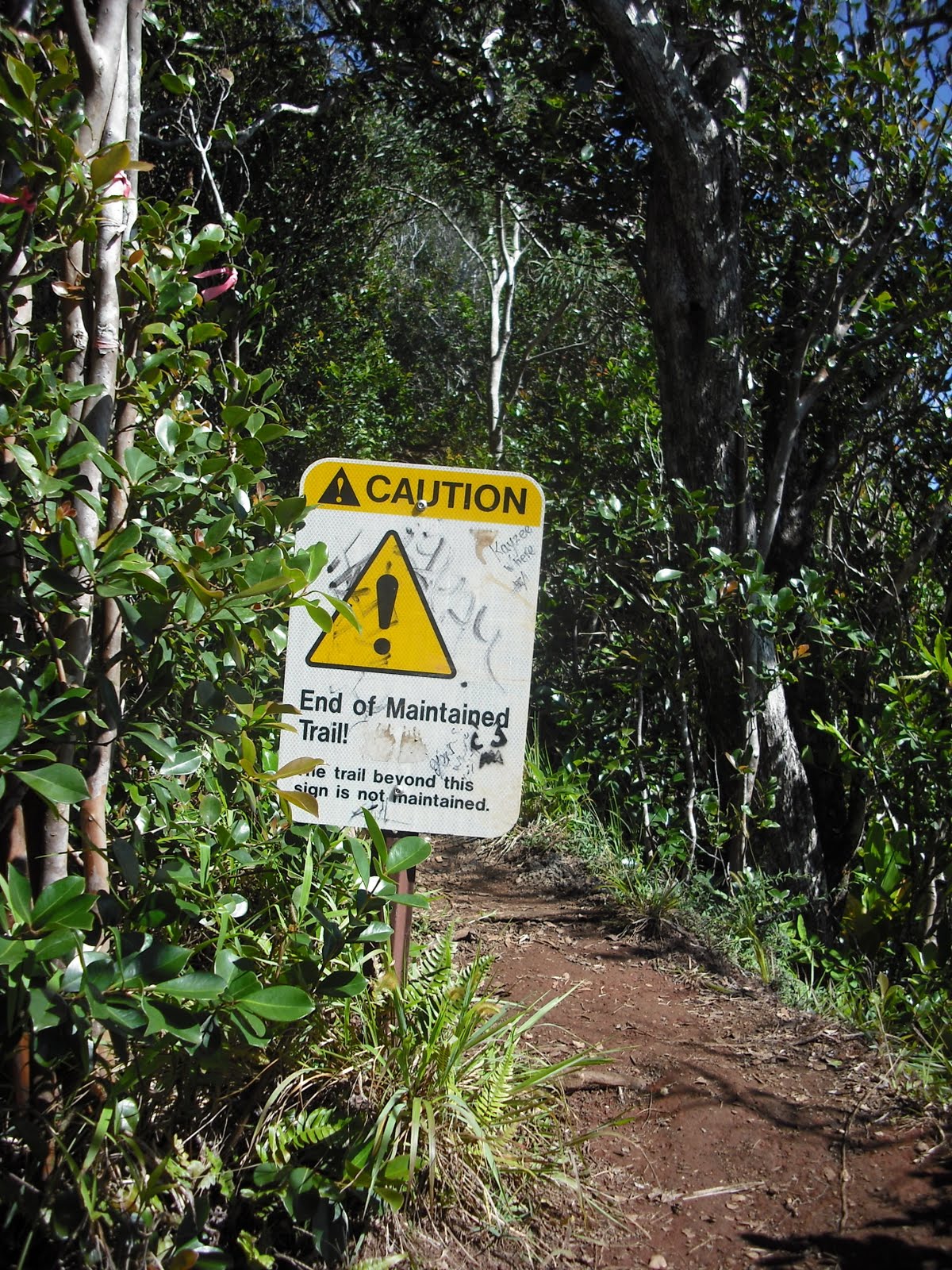
Of course, one has to ignore a few signs to get this kind of view. *heh*


Of course, marked trails cannot compare with a guide (and some...um...handholds and ropes) when trying to find the best path. Our guide, 'Ito, provided excellent guidance which, had I not cramped up, would have likely gotten us to the summit.


Our reward beyond the view and sense of accomplishment, fish tacos at South Shore Grill for lunch, an ocean swim, and some pretty fantastic Indian food with Benito and LK at dinner. Who says Sunday's fun should be all work?

3.15.2011

Hawaii 2011 (Day Four)

After the Magnum P.I. waterman day, we knew that we wanted to add a little more fitness to the routine. After all, Magnum had a steel breastplate under all that chesthair, and he didn't get it by going to picnics and sitting on the patio at the King Kamehamea club drinking beers (or did he).

We started the day with a wonderful breakfast of homemade granola, yogurt, dried cherries, and honey, thanks to Linda K., and quickly got to the business of running around Diamond Head to the Saturday Farmer's Market (it seems that it helps to get there early).


All was shaping up for fitness and the ability to get into Magnum P.I.-tight shorts (if one wanted to do this). Just then, we encountered a bit of a hitch. Soul had a booth at the market.


For the record, we SHARED the crab benedict with mango hollandaise and the "chilaquiles." We walked back to the apartment, so I figure that we worked off second breakfast. Our colorful friend seems a little suspicious of my logic, however:


Fortunately for us, the Honolulu Festival was in town. We walked to downtown Honolulu to watch hula, Japanese, Chinese, and other Pacific cultural performances. Despite the tragedy in Japan, several Japanese groups were able to come and perform (they had left before the destruction, we guessed).


Although it was all interesting, we were particularly blown away by an indigenous Australian dancing/music/culture group called "Descendance."


Of course, no walk downtown would be complete without a stop in to the Surfrider for a few tropical drinks. Despite the plastic cups, these Mai Tais were more authentic than yesterday's megadrinks at the Elks/KK club.


Of course, the view was the real attraction to this little corner of paradise.


After watching others on their boards, I'm starting to get the itch myself.


Although the running and walking seemed to help get us back on track, we didn't want Supper Club: Hawaii Edition to destroy the work/leisure balance so crucial to the Island Detective Lifestyle™. For dinner, we used much of what Linda K. found at the market.


Corn sprouts (which taste like corn!), blue sweet potatoes, local plum tomatoes, feta, and bread made this dinner particularly healthy, while it tasted like you just pulled everything out a garden (which we kind of did).


Of course, Benito was there to pour drinks (in this case, lychee saketinis), and add to the laid-back vibe. Our friends put the magnum in Magnum.

Hawaii 2011 (Day Three)

After two days of false starts and misconnections, day three of our Hawaii sojourn had a lot to live up to--fortunately, two members of our original supper club made sure that this day would count. In the morning, our fearless host Linda had secretly arranged to get us into the infamous King Kamehamea club (of Magnum P.I. fame--a show that was part of my childhood background landscape, but which has become more of my psyche, thanks to our friends Dayna and Mazz). Linda's friend Elisa has a membership to this club (an Elks Club in RL), and showed us the glamorous side of Honolulu.
Although there was no Rick, T.C., or Higgins (not to mention no damsels or sinister international types), we were able to watch whales breaking the surface in the distance. There were also some pretty fancy Mai Tais and Bloody Mary's on the menu.
Although nobody would confirm this, we're pretty sure Rick was hiding behind this particular door.
After our noon trip to the club (and a nap), we weren't finished with our beach time. After shopping and packing a picnic dinner, we walked back down to Kaimana beach for a sunset meeting with a few of Benito's and Linda's friends. Initially, we had to plunk ourselves down on the wall because of few of the locals had commandeered the usual bench.
Once we got over the shock of the change in venue (really, only about 20 feet difference from their "usual" spot), we got down to eating and drinking. Although the couscous, watercress-tofu salad, brie on french bread, ahi poke, potato-blue cheese salad, and spicy-fried tofu were divine, what really stood out was the hospitality.
Of course, the reason these are called SUNSET picnics became obvious about halfway through the meal.


Although it took a while to get here, the smiles of old friends, the hospitality of new friends, and the quiet moments of beauty can balance the weight of so many difficulties. Small revelations.

3.13.2011

Hawaii 2011 (Day Two)

By now, you know that on Friday, March 11, 2011, Japan suffered its worst disaster since WWII. Although we spent much of the day in a travel bubble (4+ hours to LAX, a layover, and 6+ hours to Honolulu), we never imagined that our first few hours in paradise would be spent with friends worrying about whether or not we would be running for the hills. Although our first sightings of Linda and Benito "stalking" us near the Honolulu airport baggage carousels with leis (and beautiful, at that) were pure joy, it did not take long to figure out that all was not right in the world. Miriam and I were exhausted from the cross-country trip, a bit discombobulated from the jet lag, and more than a bit...um...ripe from not having access to our travel bag for two days (it spent night 1 in the Fargo airport), but we were ecstatic to be on the island and in the company of friends. After a glass of champagne (Gruet, naturally!), and introduction to friends who would be leaving for Bali in the morning, we were soon greeted with hourly tsunami sirens, and a mad scramble to find out information. Our host, Linda K., was methodical in finding pertinent information (it turns out that despite our close proximity to the beach, we are not in an evacuation area). Benito and the other friends who joined us were also good at sorting through the confusion. We stayed in the second-floor apartment near Waikiki beach, but we did not sleep much. Knowing that the first tsunami wave was supposed to hit at around 2:38 a.m. made the 2:34 a.m. tsunami siren all the more frightening. As is obvious, we made it through the night. Thank you everyone who has expressed concern for our well-being. We are fine. We hope you direct your attention to the people of Japan, who have, and continue to suffer unimaginable suffering because of the earthquake, tsunami, aftershocks, and nuclear plant problems. It is good to have friends near and far, and I think Japan will need friends from all over to get through this.

3.12.2011

Hawaii 2011 (Day One)

Sometimes, the best parts of the trip are the unexpected surprises. Not today. Mechanical problems with the jet that was supposed to start our journey to Hawaii proved that serendipity doesn't always rule the day.

We made it to Chicago and stayed near the airport. About 12 minutes before our already-delayed flight was supposed to depart, I was aware enough to call the airline. Incidentally, this is a very good idea if you want to get rerouted. For the record, United Airlines was very nice and as accommodating as they could be under the circumstances.

Was it was nice to get out of town? Yes, but there doesn't seem to be any grand lesson to learn in this particular missed connection (beyond obvious humility. Let's be honest here, though--even I don't feel like I'm in control of large jets).

On the plus side, our Chicago hotel bed was nice, and certainly better than staying in O'Hare overnight, which I have done). Next stop, Hawaii?

3.02.2011

The Kids Are Definitely All Right

Lisa Cholodenko’s "The Kids Are All Right" does what few comedies have dared to do in quite some time--it examines the slowly fraying edges that inevitably result when people make long commitments to one another, and it does it with both ferocity and tenderness. Although the central differences that the characters Nic and Jules (the protagonist mothers--played by Annette Bening and Julianne Moore) have with heteronormative Hollywood productions inevitably draws the attention of cultural critics, the heart of this movie resides in familial relationships that the children (18 year-old Joni and 15 year-old Laser--played by Mia Wasikowska and Josh Hutcherson, respectively) have with their two moms and the "interloper" sperm-donating father Paul (played by Mark Ruffalo). Of course, the norms that the characters adhere to are as heteronormative and patriarchal as the values that the lesbian mothers battle; still, these norms are at once more sublely-played and powerful than the heterosexual economy that the seducing Paul re-introduces into Nic's and Jules' love equation. This movie foregrounds a highly-emphasized sexual motif, with several sexual encounters between characters--and even a rather stylized gay porno-- and rather graphically emphasizes the sexual implications of life choices. Underneath the encounters and cuckolding, however, lies more profound feelings of abandonment, insecurity, longing, and wishing.

Laser's desire for a fatherly connection awakens after his awkwardly-bullying friend/acquaintance Clay gets into a very rough wrestling match with his own dad. Laser, a rather quiet teenager, convinces his sister Joni to look up and contact their biological father Paul, and the once-clear family lines begin to cross. The viewers initially get to see Nic and Jules as a rather normal couple, with separate identities and different power situations. Nic, an OB-GYN is played somewhat unflatteringly, though humanely. Nic's obviously the breadwinner, and brooks little discussion on matters of protocol or propriety. Jules provides the bulk of the nurturing for the family, and we meet her as she is trying to launch a landscaping business. It is during the scenes where Nic and Jules discuss her fledgling business, and during dinner interactions that we see that Jules is somewhat inarticulate and at a disadvantage to Nic's well-polished, disciplined, yet often cold demeanor. Clearly, these two people love each other, but 18+ years with two children have required compromises, and it looks like Jules' flakiness has provided much of the cushion.

The entrance of a very sexual, and casually entitled Paul (he enters not by design, as it was the children who asked for his presence) happens at Jules' emotional ebb. His affirming and flirtatious support of Jules' career through a backyard commission quickly turns physical, as Paul does not miss a chance to compliment Jules' work, philosophy, and looks. Moreover, he does not turn her advances back, as his encounters with his biologically-connected kids awaken feelings of yearning for rootedness and even a family of his own. The physical relationship that ensues seems sadly funny, as both of these characters don't know where the "off" switch resides. Jules' knows that she loves her family, but she cannot stand up for her own needs, and Paul doesn't know how to appreciate what he already has. Paul's need to stay open for the advance puts everyone into an awkward position, as families do not have the same kind of resilience as the young women he has bedded. Or do they? As this family goes churns through the crisis, you find out that Jules' has much more strength and sticktuitiveness than first portrayed. She provides the climactic and heart-wrenching living-room talk that reveals just how aware she is that she has betrayed, and has been betrayed by, the woman she loves. The "marathon" she describes is one that Nic must also admit to--Nic's uncomfortableness with her physiciality, her easy comfort with overdrinking, overstating opinions, and her overdependence on her economic and professional superiority all come crashing down. She knows that she's been shutting out Jules, and only the quiet affirmation of Jules' worth can help her meet the inarticulate and wounded heart of her partner on more equal ground. This reversal of Jules' and Nic's articulateness marks the turn in admitting that they don't know how things will turn out, but that they are committed to each other and their children regardless.

While the acting is generally very good, Julianne Moore's acting comes across as genuinely rich. Ms. Moore shows an attention to character that I have not seen in any of her roles (she generally depends upon the depth of her expressive eyes--something I might attribute to her choice of roles in thrillers and dramas). Annette Bening is, as usual, excellent. She presents a bit more of a hard edge with her silent cruelties, but underlines her role with a genuine warmth. Unlike her role in American Beauty, she is a sympathetic character (as are all of the characters--including Mark Ruffalo's clueless lothario).

What is genuinely a delight, though emerges from the way that Laser eventually enunciates the heart of the family. His rejection of Clay (during his "friend's" attempt to urinate on a stray dog) and his embracing of his mothers, with all of their flaws, provide a bit of honesty to the perfectionism of Nic and Joni and the self-doubt of Jules. Probably not "Best Picture" material, but a pretty frank and, ultimately hopeful, look at the contrast between family dreams and family realities.

2.17.2011

Boys to Men

Contemporary global culture celebrates movies, the opera of our contemporary historical moment, in some surprisingly limited ways. There is much made about the technical artistry of movies, the quality of the visual effects, the acting, and the poetic sensibility of the storytelling. Additionally, critics and awards organizations recognize movies that capture a particular zeitgeist--movies that, say, reinvigorate our belief in simple, yet absorbing worlds (Star Wars), or that make us feel better about our chances to have an impact on the world (Rocky). Much less celebrated are the movies that touch our ethical sensibility, that guide our sense of how one negotiates the world's complicated, and often contradictory demands. Movies that give us these ethical touchstones are only celebrated when wrapped in an epic (Dances with Wolves) or historical (Schindler's List) sensibility.

Small, quiet movies that explore the paradoxes of a life well lived (Groundhog Day, The Fisher King) typically fall under radar, and only find their audience through word of mouth. One movie that was lucky enough to find an audience did so by disguising itself as a contemporary Brit-com in the tradition of Four Weddings and a Funeral and Love, Actually. This movie, About a Boy, stars the same troubled, but charming, adultboy Hugh Grant. In this movie, the manboytagonist Will provides the narration about his lonely life of abundance. Will employs disarming banter about how he eschews complications from his relationships and structures frittering away his days (using interchangeable "units" to describe what are essentially luxurious distractions). The viewer can be very easily taken by Will's roguish disaffectedness, and is invited to do so with long looks at Will's luxury loft-style apartment, his modernist furniture, an eclectic collection of hobbies, and an even more exotic collection of girlfriends. Rather unsubtlely, Will's opulent, but empty existence gets contrasted with a rather unflattering portrait of "the boy" (Marcus, played by Nicholas Hoult) and his mother Fiona (played by the inimitable Toni Colette). Marcus, a rather awkward tween, ineffectively fends off school bullies and tries to understand why his granola-laden mother unhappily keeps trying to kill herself. Even though the audience could get backstory to understand what drives Fiona to her suicidal maudlin behavior, or why Marcus never seems to defend himself, we are denied that background. Instead, the audience is allowed the discomfort of admiring a trust-fund nothing and feeling less sorry for two characters in truly pitiable circumstances.

The reversal of charisma that arights this ethical incongruity hinges on Will's attempts to pick up on single mothers (the chant of the group SPAT, "Single Parents Alone Together!" is almost worth the price of admission alone). Will's narration on his reasoning for picking up on single parents only highlights just how emotionally parasitic he is, and just how little he actually lives up to his credo that "all men are islands." By plugging into the emotional needs of single mothers to increase his own ego, and then taking advantage of those mothers' ambivalence towards an emotional competition with a child to provide an easy exit, Will harvests the emotional void of vulnerable people. It is in this scenario that Marcus sees an opportunity to harvest Will's emotional void through blackmail. Marcus, like Will has a shaky relationship with any male figure (something that becomes abundantly clear when he volunteers to play "Killing Me Softly" during the high-school talent show using only his squeaky voice and a sad little tambourine). Unlike Will, though, Marcus is not yet resigned to always taking or buying the simularcrum of love where he can from the women in his life. Instead, Marcus still seeks authentic relationships with women, and instead enters a more capitalistic emotional exchange with boys and men (especially Will).

During the initial stumblings of their relationship, Will and Marcus attempt to steer each other toward the heteronormative and capitalistic models for different-sex relationships. Marcus tries to set Will up as a romantic partner with his mother, Fiona (at the same time Will is desperately trying to figure out how to have an honest relationship with Rachel--played by Rachel Weisz]). Meanwhile, Will is trying to buy Marcus' good graces by using a bit of his trust-fund money to buy him shoes and music. Both of these schemes to buy/force love fall flat, and Will and Marcus are both left trying to square up with people who genuinely like them, but with whom they feel like they cannot fully connect. Rachel's child (a bully) hates Will and bullies Marcus to hog his mom's energy. Fiona sees through Will's strategies, and eventually exposes his masquerades as a single father. The difficulties that Will and Marcus face creating an atmosphere of honesty and trust seem insurmountable, as both of them come from an emotionally stunted upbringing ("No. No. You've always had that wrong. I really am this shallow. ").

It's only at the moment that you think that Will and Marcus aren't going to ever make the connection that you learn about Will's and Marcus' connection to an overshadowing parent. Marcus' social suicide attempt at the talent show somewhat melodramatically folds in Will's disconnection with his now-dead songwriting father who left him a small fortune, but seemingly never helped him grow up. The solo (which eventually becomes a duet) takes the title "Killing Me Softly" rather literally. Fiona encourages a show of love that will likely seal Marcus' fate as the bottom rung on the social ladder, and Will exposes the fact that his father's "one hit wonder" musical fortune buried any chance that he would grow out of his childish need to buy affection. The song that pays Will royalties ("Santa's Super Sleigh") has really been killing Will emotionally.

Fortunately, this show of solidarity on the stage has all of the right people watching, and forges a real connection between the formerly disconnected characters. This neat tying-up of narratives avoids cliché in how it handles the resolution. Instead of re-establishing the heteronormative and capitalistic order, Will's narration takes a decidedly ethical turn in announcing that "every man is an island. I stand by that. But clearly some men are island CHAINS. Underneath, they are connected." Marcus adds to this narrative (a narrative echo to the musical duet) by building on that Robinson Crusoe-esque observation: "I used to think two was enough. But now things are great; there are loads of people... I don't know what Will was so pissed about. I don't think couples are the future. The way I see it now, we both got back-up now. It's like that thing Jon Bon Jovi said: 'No man is an island.'"

Even further, Will discovers the secret to really connecting with and loving others resides not in the one-to-one exchange that he excels in (and something that compels him to maintain the illusion of desirability, ultimately leading to the lies he constructs to maintain that illusion), but rather in accepting, supporting, and loving the people that those people love. To care about someone means you have to genuinely care about the people that someone has in their lives. Will grows by spending time with everyone in Marcus' life, by sharing who he is with everyone, and by accepting and helping those on the edges of Marcus' and Rachel's life. Marcus' and Will's shared humiliation on the stage provides the metaphor to guide their interactions with others around them. Marcus becomes visible to loved ones and possible friends for the first time and Will can finally offer something of substance because of the courageous stand they both take on the most fickle of stages.

In the end, no character changes so much as they emerge into honesty. Marcus is still awkward. Will is still struggling to grow. Fiona is still depressed. Despite these flaws, each has prospects, both in romantic love, and, more importantly in family.

2.06.2011

2011 Spring Fitness Goals Log: Week 3

Bench Press: 82%
Squat Press: 70%
Standing Curls: 80%
Military Press: 75%
Gymnastic Situps: 100%
Indo Balance Board: 7 minutes
Yoga: 1 day - short session
Short Run: 3 miles (speed), 2 miles (speed)
Long Run: 11 miles (speed)

On the Interwebs

1.26.2011

2011 Spring Fitness Goals Log: Week 2

Pull-ups: 66%
Dips: 92%
Seated Dumbbell Reverse-raises: 70%
Shrugs: 60%
Sit-ups: 100%
Yoga: 1 day - short session
Short Run: 3 miles (speed)
Long Run: 7 miles (speed)

1.17.2011

2011 Spring Fitness Goals Log: Week 1

Bench Press: 82%
Squat Press: 65%
Standing Curls: 80%
Military Press: 67%
Indo Balance Board: 5 minutes
Yoga: 2 days - short session
Short Run: 4 miles
Long Run: 10 miles

1.10.2011

Movie Editing as Gender Construction

Editing can have HUGE implications for how one experiences a film/video. When Peter Ramus divided invention from what he thought were the ornamental elements of rhetoric, he failed to see the constitutive powers of arrangement and style. To illustrate my point, I'm going to contrast two trailers for the surfing documentary Step Into Liquid. In each trailer, notice who speaks first, who speaks most, and note the way that the genders are portrayed.

In the first, more gender-balanced trailer, note how the title of the movie is derived from an interview with Rochelle Ballard, one of the best professional surfers on the tour. She distills the joy of surfing by describing it as stepping into liquid. In the trailer, you see her discussing surfing in philosophical and intellectual terms. There is a moment where she descibes it more sensually. In this first trailer, you only hear her at this moment, and see her during her more serious moments. The gender balance in this trailer is also much more obvious, with cuts between male and female surfers. Women are portrayed in active poses, with the climactic scene of a woman doing a backflip off of her surfboard.


In the second trailer, there is a hyper-masculine narrator using an aggressive and superlative tone ("the Browns have done it again"). Men are the first people you hear (rather than the woman whose interview inspired the title). The same footage of Ballard shows the moment when she's discussing surfing more sensually ("it just feels good") with her scrunching up her shoulders and appearing a little more flaky. The footage of the surfers is more segregated by gender, and there is a marked difference between the ways that men are described (men are identified as parts of groups, and doing more aggressive and accomplished feats--"strapped crew," "the Maverick's crew," "the war veteran," "surf legends," "The Malloys, etc.") vs. the women (who are described individually, and as being part of a setting-- "in beautiful Tahiti").


The addition of the throbbing music to the more masculinized soundtrack merely serves to underline the gender posturing in this short piece. While the additive elements of the voiceover and the soundtrack underline the difference, the editing is really what does the heavy lifting. Segregating different gendered surfing footage and featuring the more sensual, slow motion, and closer shots of women, while featuring the more active men through the use of helicopter "God's eye" shots of men skating across the face of larger waves in real-time constructs the binaries of men as active and aggressive and women as soft and more passive. The declaration that "the Browns have done it again, and this time they're showing the simple truth about surfing" (with the images of exclusively-male images of big-wave surfing), followed immediately by spliced audio explaining "big wave riding is like an inner desire" only cements the naturalized ordering of big wave riding (done by men as "the truth" of surfing) as the top of the hierarchy.

Subtle differences to the untrained eye, but unmistakable compositions that cement associations between gender and activity through image. Splicing flickering signifiers in particular sequences creates the multiple gendered truths of surfing from the same raw material.

1.06.2011

Running into a Blizzard

When my partner and I were interviewing for our two jobs at NDSU, we asked a graduate-school friend from Minnetonka, Minnesota about the chances of us surviving up here on the northern plains; “you are moving to a cold, dark hole, but the people who live there are really nice.” Foreboding description, but we took the leap anyway. Since we moved, we have found he description apt for the most part, and have been learning to embrace life up here. We’ve picked up cross-country skiing, run through blizzards, and even built slide-distance into our driving calculations. Still, we have never been stranded in a car during a blizzard. Correction: we hadn’t been stranded in a car until December 30, 2010.

As you already know, we survived this seemingly-shocking event, and have emerged pretty much unscathed. Perhaps the weirdest part of being in a car that slides into a snow bank during the middle of a blizzard is the strange mundanity of it. What went through my head was really something more like a combination of confusion and of comfort. The bizarre juxtaposition between the almost-unimaginable slide of a 2-ton car on a dark, icy road and the almost cheerful camaraderie of three friends going into the unknown still jars my imagination. There was no question what was driving us—the chance to spend this belated birthday celebration eating incredible Korean food with an old friend (it was going to be two old friends, but one was quite sick at home) and two new friends was too much to pass up.

When the snow settled, and the requisite attempts to free the car using drive and reverse failed, my friend Dayna, my partner Miriam, and I looked at each other for answers. Luckily, both of the other people stuck in this absurd situation with me are can-do folks--within minutes, we were all out trying to push the car off of the snow berm and back onto the road. We hacked away at the snow with both hands and an ice scraper. Our gregarious driver asked a police officer to call a tow-truck (none of the 18 tow-truck services would come down as far south in Moorhead as we were), called her insurance company, and flagged down a fellow stranded motorist to help free us; Miriam and I took turns pushing, gunning the car, and digging. Ultimately, the combination of near-gale winds and ice-rink surface of the road forced us to call our dinner hosts to see if we could make a run for their apartment. After a few calls back and forth (what did we DO before cellphones?), we made a run for it, and was met by one of our hosts (a Texas native, but surprisingly adept running through the snow) about 1/4 mile from the car.

As you may suspect, we made it to the dinner (which was even better than I imagined). The food, conversation, and hospitality were amazing, especially considering the circumstances; still, I can’t help but think back about what my Lake Minnetonka friend told me. Most people think of place as something that gets characterized by its natives. Although Dayna is from here (and has been a delightful guide in discovering both basic and urbane aspects of the culture), our hosts are from South Korea and Houston. Miriam and I hail from Florida and Arizona. Despite (or maybe because of) our diversity, we were able to get to the dinner, have a great dinner, survive an impromptu sleepover, and get home. The combination of difficulties and friends to face them have only cemented my feeling that Fargo is now my home--a place where even the worst of circumstances can add to my love of place.

11.28.2010

Deal Making/Deal Breaking: Of Hitler and Incommensurability

Today, during a Master's thesis prospectus meeting, Hitler made his rounds. In discussing how an M.A. candidate might frame the rhetoric of militant Hindi fundamentalism, the committee discussed Hitler's use of rhetorical violence during the Third Reich (Burke, the rhetorician of choice, studied Hitler's rhetoric, so it was a fair invocation). Still, I notice the usefulness of inserting Hitler in academic and cultural discussions to clarify otherwise unclarifiable discussions. Hitler helps clear the air for people with strong agendas. We can all agree that Hitler was bad, so we can't be that far apart (or something like that). Although it doesn't always take this kind of Armageddon-like common ground to get academics to agree on things, it often helps.

One-on-one, I almost never need to rush to some sort of cultural extreme (like celebrity bad behavior) or historical extreme (like Hitler) to gain common ground with people. I usually can see and acknowledge a wide range of perspectives as part of my nature. I perceive things in their context, and I usually find common ground unless I see imminent danger. I accept. As a pre-teen, I was nicknamed "peacemaker" by my parents because of my role in mediating between between brothers and between the sibling/parent divide. My perspective helped me translate what was often mutually excluding frames of seeing the universe. For quite a long time, this role was a way to gaining prestige and getting the love and respect I craved from my family and friends. I could identify with others and give them both a nonjudgemental, and sometimes idealized, version of themselves. In Enneagram terms, I'm a nine (with a one wing, for those who are Enneagram geeks). Although some people were/are suspicious of this (I've been called smarmy more than once), it is a totally sincere perspective. To quote one of my favorite poems: "I know many lives worth living."

Although being a mediator may seem like a pretty comfortable place to live, it often presents with unsolvable puzzles. When I am positioned between two incommensurable people or positions, my translations can become conduits to rage and inflexibility. I discovered this as a teenager when my older brother slowly inducted me into his fundamentalist Christian Bible study. I gave my best effort to syncretically integrate my old habits/hobbies/perspectives (reading, love of a wide range of music, fantasy gaming) with the perspective of a new creation (or at least the late-20th Century American version of it). Eventually, I was forced to choose between the Fellowship of Christian Athletes and Top-40 music, between loving Jesus and playing Dungeons and Dragons. Eventually, I decided to chuck my past into the garbage can (quite literally, in the case of my fantasy gaming books--Dungeon Master no more). Underneath my embrace of Christian fundamentalism, I still held a rich imaginative and intellectual life, but I did so in secretive and what felt like duplicitous ways. It took me four years, and an immersion in Southern California's much more eclectic music sub-culture to face up to my mistake. It took a lot of hurt feelings and sadness (even yelling) to remove myself from what I felt was an overly-rigid perspective,. I don't believe in Christian fundamentalism, despite my ability to understand those who embrace it. Nevertheless, I try to steer clear of strong expressions of it because I know that my understanding, and even fondness for some of its adherents, will be mistaken for a willingness to embrace it.

The problem for me was one of finding myself in-between two totally different perspectives and lacking the ability to persuade one of reconciling the other. I can hold two truths in my head, but I can't live in two worlds. My peacemaking blessing can be a curse when I get between two inflexible and incommensurable people or institutions.

Why does this matter? Well, in my new role as director of Upper-Division Writing, my job is to act as a gatekeeper between students who want nothing more than to get through their education and an institution designed to throw up challenges. My job is to become an apologist for one side (the student's) while serving the will of the other (the University). How does one deal with this? I have to look outside myself, step away from my peacemaking role and lean into my life choice. I chose to be a director, and that means some people are just going to be pissed off. There are no comfortable cultural examples to point to when I stand between a two forces and their colliding goals. There is no Hitlerian high ground, so sometimes I just have to, in the words of LBJ, take it like "a jackass in a hailstorm."

11.24.2010

Humpbacks

by Mary Oliver


There is, all around us
this country
of original fire.

You know what I mean.

The sky, after all, stops at nothing, so something
has to be holding
our bodies
in its rich and timeless stables or else
we would fly away.

Off Stellwagen
off the Cape,
the humpbacks rise. Carrying their tonnage
of barnacles and joy
they leap through the water, they nuzzle back under it
like children
at play.

They sing too.
And not for any reason
you can't imagine.

Three of them
rise to the surface near the bow of the boat,
then dive
deeply, their huge scarred flukes
tipped to the air.

We wait, not knowing
just where it will happen; suddenly
they smash through the surface, someone begins
shouting for joy and you realize
it is yourself as they surge
upward and you see for the first time
how huge they are, as they breach,
and dive, and breach again
through the shining blue flowers
of the split water and you see them
for some unbelievable
part of a moment against the sky-
like nothing you've ever imagined-
like the myth of the fifth morning galloping
out of darkness, pouring
heavenward, spinning; then
they crash back under those black silks
and we all fall back
together into that wet fire, you
know what I mean

I know a captain who has seen them
playing with seaweed, tossing
the slippery lengths of it into the air.

I know a whale that will come to the boat whenever
she can, and nudge it gently along the bow
with her long flipper.

I know several lives worth living.

Listen, whatever it is you try
to do with your life, nothing will ever dazzle you
like he dreams of your body,

its spirit
longing to fly while the dead-weight bones

toss their dark mane and hurry
back into the fields of glittery fire

where everything,
even the great whale,
throbs in song.

11.03.2010

Election Hangover


Today, a lot of my friends are feeling pretty blue about yesterday's election. While I sit pretty firmly on the progressive side of things, I have to say that I'm not nearly as down about what happened. Despite my militant (and often annoying) optimism, I actually think that keeping the Senate gives us a lot to be hopeful about. Things did not go as I had wished; however, I'm pretty sure that we can turn things around if we get involved.

How can I be so sure? Well, nothing is sure, but this reminds me of my despair 4 years ago when I saw George W. Bush get re-elected by my state (Ohio), despite what felt like a mountain of energy expended on fundraising, canvassing, and even election monitoring. That election, while standing in the rain as a monitor, I was repeatedly and randomly ordered by a 19-year-old police officer to cross the street. I saw developmentally-disabled people escorted into a voting booth one-at-a-time by a single Republican Party muckity-muck. I saw live newsfeeds of Ken Blackwell (George W. Bush's campaign crony and eventual Governor candidate) counting votes behind closed doors while stonewalling press access. My partner and I felt generally despondent after my country re-elected an incompetent President and my state turned out in great numbers to marginalize my LGBT friends and fellow countryfolk. We were so devastated that the first thing we did was drive to a blue state (Michigan) and buy a blue couch.

That despondency didn't last, however. When the dust settled, sport and I just doubled down and worked that much harder. We joined a local group and started talking politics with our friends in coffee-shops and offices. Every week. It was really nothing crazy, but it wasn't easy either (I still have hate mail from people who didn't like professors writing letters to the editor--the horror!). We just started caring and putting our time and money where our hearts were. We articulated a vision and worked towards it. Unsurprisingly, we found that a lot of people either agreed, or were just looking for somebody else to care. We changed minds. Long story short? By the time we left for North Dakota two years later, Ohio had elected President Obama, voted in a Democratic governor (and several new Democrats) and cleaned out much of the corruption that we saw rip apart our faith in American democracy.

Don't lose sight of the fact that we make our own hope, and that we can only win if we share that hope. Every. Day.

Chin up. We've still got a chance to change the world for the better. Let's get working!