10.04.2005
In case you haven't heard
So, you may have heard a thing or two about the film school editing project that hit the meme-stream, and, lickity-split, this lad has calls coming in from Hollywood. Now, I could reinforce the idea that all one has to do is to just do good work and put it on some secret server and that dream job will come calling. Sometimes happens, but not often. Instead, I'm struck by the irony of a person remixing Hollywood intellectual property (in this case, turning footage of The Shining into a parody of a comedy trailer), and when it gets out into the public domain, the "Pirate Hunters" offer this guy a job. Reminds me of when hackers were getting jobs as computer security consultants (my boss' son actually made 100 million dollars when he ditched his military decryption--a.k.a "hacker"--job to build and subsequently sell a computer security firm). I think it reveals the motivations of the culture industry in enforcing intellectual property "rights." So-called "Liberal" Hollywood is all about the bling.
10.02.2005
So I Went to See "Serenity"
I'm not going to give *much* in the way of spoilers here, but don't read this if you want to see the movie.

A few random thoughts about the movie.
1.) Great television show, good movie. Joss Whedon had some of the most innovative science fiction writing and filming with this show, so it is hard to make it more "innovative." I wish he had about 10 million more for special effects and about 10 million for marketing.
2.) The dialogue was still good. Joss has a way of "scuffing" dialogue. In this movie, he rubs western cliches against science fiction, with a generous dose of humor. It works really well--way better than "Buffy" ever did, in my opinion. I just don't cotton to valorizing high school talk. I didn't respect it when I was in junior high or high school, and I still don't respect it. Now, I don't like Western conventions because I grew up on a reservation, but I find that the mixture of speaking virtuosity, constant character attempts to decipher what the others mean, humility, and humor sounds exactly like what I remember on the rez. Last show I remember doing the same thing was Northern Exposure, but I digress.
3.) The "imperfect" film technique (CGI odd angles, treating the ship like a character, putting in light flares and off-center shots) makes this "Millenium Falcon-Stagecoach" (Whedon called his show this in the first season DVD documentary) scenario feel more authentic. George Lucas could have saved a lot of money and grief had he just kept more imperfections to let people get closer. After the first two Star Wars movies, I stopped caring about the characters. In Firefly, and Serenity, I never stopped caring. I think this is a result of Lucas making his films more technically correct and cold and Whedon keeping the focus on the characters, including the spaceship, as imperfect, and imperfectly knowable.
4.) The characters. I can't believe that my favorite character doesn't make it. I felt like I lost a best friend, and I'm still in denial. Seriously. I've never EVER mourned a fictional character, and I mourn this poor soul.
5.) My biggest gripe with with the use of Papyrus font for not only the poster (puh-leeze hire a better marketing firm--one that doesn't double as a wedding invitation publisher), but also as the lettering on the side of the Serenity. As a typography geek, I am offended that someone would spend millions to make sets look completely real, but won't take a trip down the mac font menu to see how incredibly common their font choice is. Everyone with any passing typographical experience (you know, educated people who work at their desks) will probably recognize this as a ready-made font. The font choice is what most people will notice when they see the poster and trailer. While they were at it, maybe they could have included some Word clip-art too. The coup de grace was when Inara is seen painting the same font on the side of the ship at the end. Wow, that's bad. I know, only a typographic geek would care. Still, all of the work that is done to make the movie live and breathe as a unique world should extend to the invitations (trailer, movie poster, internet banner ads). Wait! Maybe they should have hired a custom wedding invitation company to make the poster. I'm sure they have tons of interesting fonts...
A few random thoughts about the movie.
1.) Great television show, good movie. Joss Whedon had some of the most innovative science fiction writing and filming with this show, so it is hard to make it more "innovative." I wish he had about 10 million more for special effects and about 10 million for marketing.
2.) The dialogue was still good. Joss has a way of "scuffing" dialogue. In this movie, he rubs western cliches against science fiction, with a generous dose of humor. It works really well--way better than "Buffy" ever did, in my opinion. I just don't cotton to valorizing high school talk. I didn't respect it when I was in junior high or high school, and I still don't respect it. Now, I don't like Western conventions because I grew up on a reservation, but I find that the mixture of speaking virtuosity, constant character attempts to decipher what the others mean, humility, and humor sounds exactly like what I remember on the rez. Last show I remember doing the same thing was Northern Exposure, but I digress.
3.) The "imperfect" film technique (CGI odd angles, treating the ship like a character, putting in light flares and off-center shots) makes this "Millenium Falcon-Stagecoach" (Whedon called his show this in the first season DVD documentary) scenario feel more authentic. George Lucas could have saved a lot of money and grief had he just kept more imperfections to let people get closer. After the first two Star Wars movies, I stopped caring about the characters. In Firefly, and Serenity, I never stopped caring. I think this is a result of Lucas making his films more technically correct and cold and Whedon keeping the focus on the characters, including the spaceship, as imperfect, and imperfectly knowable.
4.) The characters. I can't believe that my favorite character doesn't make it. I felt like I lost a best friend, and I'm still in denial. Seriously. I've never EVER mourned a fictional character, and I mourn this poor soul.
5.) My biggest gripe with with the use of Papyrus font for not only the poster (puh-leeze hire a better marketing firm--one that doesn't double as a wedding invitation publisher), but also as the lettering on the side of the Serenity. As a typography geek, I am offended that someone would spend millions to make sets look completely real, but won't take a trip down the mac font menu to see how incredibly common their font choice is. Everyone with any passing typographical experience (you know, educated people who work at their desks) will probably recognize this as a ready-made font. The font choice is what most people will notice when they see the poster and trailer. While they were at it, maybe they could have included some Word clip-art too. The coup de grace was when Inara is seen painting the same font on the side of the ship at the end. Wow, that's bad. I know, only a typographic geek would care. Still, all of the work that is done to make the movie live and breathe as a unique world should extend to the invitations (trailer, movie poster, internet banner ads). Wait! Maybe they should have hired a custom wedding invitation company to make the poster. I'm sure they have tons of interesting fonts...


10.01.2005
Freakonomics Blog
Just bookmarking this so I can put it in the links later. Remember when blogs did that?
9.30.2005
Friday Teacher Blogging

Dr. Sean Grass is a little scary, but when he's on his game teaching Victorian culture, you can't leave the classroom without learning a LOT about the period.
9.29.2005
Sub-$100 Notebook
Now, THIS is a useful device. Give laptops to the world's poor. This is absolutely HUGE for electronic literacy.
*snip*
Children in Brazil, China, Egypt, Thailand, and South Africa will be among the first to get the under-$100 (£57) computer, said Professor Negroponte at the Emerging Technologies conference at MIT.
The following year, Massachusetts governor Mitt Romney plans to start buying them for all 500,000 middle and high school pupils in the state.
Professor Negroponte predicts there could be 100 million to 150 million shipped every year by 2007.
*snip*
Children in Brazil, China, Egypt, Thailand, and South Africa will be among the first to get the under-$100 (£57) computer, said Professor Negroponte at the Emerging Technologies conference at MIT.
The following year, Massachusetts governor Mitt Romney plans to start buying them for all 500,000 middle and high school pupils in the state.
Professor Negroponte predicts there could be 100 million to 150 million shipped every year by 2007.
And what is your technique?
Genius lies not in the technique, but in the belief involved.
*snip*
Adrien Brody, who plays heartthrob writer Jack Driscoll, is known for taking a Method approach to his roles. For The Pianist, he learned how to play Chopin; for The Jacket, he locked himself in isolation tanks until hallucinations set in. Jack Black's method is to sneak Megadeth references into his movies.
*snip*
Adrien Brody, who plays heartthrob writer Jack Driscoll, is known for taking a Method approach to his roles. For The Pianist, he learned how to play Chopin; for The Jacket, he locked himself in isolation tanks until hallucinations set in. Jack Black's method is to sneak Megadeth references into his movies.
9.27.2005
Shout Out of the Datacloud
Johndan Johnson-Eilola, out at Datacloud blogs about all variety of tech stuff. He mentions something I've been writing about; I email him; he blogs about my email. Cool!
9.23.2005
9.22.2005
Super Cool
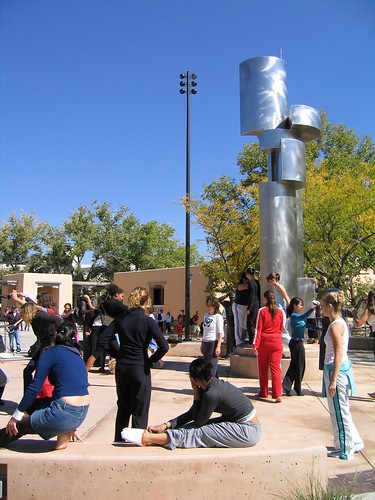
New Mexico State student to call Cal game in Navajo
Associated Press
LAS CRUCES, N.M. -- New Mexico State student Cuyler Frank entertains his friends and others in the stands with his mock play-by-play during Aggie home games, but he will get to do the real thing in his native language when NMSU hosts No. 13 Cal on Friday.
Frank, who is from Newcomb, will team up with Lanell Pahe of Crownpoint to broadcast the game in Navajo. It will be available on the university's Web site.
"I want to do the games in Navajo because I want to share some of the experiences of New Mexico State students with the Navajo Nation," Frank said. "It gives us a chance to share with our people what is going on here and what we are accomplishing as Navajos."
Several stations already broadcast high school games in Navajo, but Friday will mark the first time an NMSU football game has been broadcast in the language.
The Navajo Nation spans New Mexico, Arizona and Utah and is home to more than 250,000 people.
NMSU President Michael Martin said he's proud of the students who are taking the initiative to expand the school's ability to reach every citizen.
"Their willingness to tackle this challenge and be part of the expanding NMSU Aggie Planet is indicative of the importance we place on reaching all communities," he said Wednesday.
The effort also gives the school's Navajo students a new way to communicate with those back home.
"We don't hear much sports broadcasting in Navajo," Pahe said. "There is nothing like it. Most of the elders don't speak English very well. It gives them a new opportunity to see what is going on outside the [Navajo] nation."
Shandeen Curtis, a student athletic trainer with the football team and a Navajo from Kirtland, said the broadcast is an opportunity not only for people who enjoy listening to the game but also to bring new fans to the program.
"We have a great sports program and we are building something special here," she said. "If people listen, we can develop a following and they can see a program that is ready to take off."
The challenge for Frank and Pahe is that Navajo is very different from English. For example, there's no word for first down.
"It takes nearly twice as long to say something in Navajo as it does English," Frank said. "I've just got to concentrate on the basics.
Associated Press
LAS CRUCES, N.M. -- New Mexico State student Cuyler Frank entertains his friends and others in the stands with his mock play-by-play during Aggie home games, but he will get to do the real thing in his native language when NMSU hosts No. 13 Cal on Friday.
Frank, who is from Newcomb, will team up with Lanell Pahe of Crownpoint to broadcast the game in Navajo. It will be available on the university's Web site.
"I want to do the games in Navajo because I want to share some of the experiences of New Mexico State students with the Navajo Nation," Frank said. "It gives us a chance to share with our people what is going on here and what we are accomplishing as Navajos."
Several stations already broadcast high school games in Navajo, but Friday will mark the first time an NMSU football game has been broadcast in the language.
The Navajo Nation spans New Mexico, Arizona and Utah and is home to more than 250,000 people.
NMSU President Michael Martin said he's proud of the students who are taking the initiative to expand the school's ability to reach every citizen.
"Their willingness to tackle this challenge and be part of the expanding NMSU Aggie Planet is indicative of the importance we place on reaching all communities," he said Wednesday.
The effort also gives the school's Navajo students a new way to communicate with those back home.
"We don't hear much sports broadcasting in Navajo," Pahe said. "There is nothing like it. Most of the elders don't speak English very well. It gives them a new opportunity to see what is going on outside the [Navajo] nation."
Shandeen Curtis, a student athletic trainer with the football team and a Navajo from Kirtland, said the broadcast is an opportunity not only for people who enjoy listening to the game but also to bring new fans to the program.
"We have a great sports program and we are building something special here," she said. "If people listen, we can develop a following and they can see a program that is ready to take off."
The challenge for Frank and Pahe is that Navajo is very different from English. For example, there's no word for first down.
"It takes nearly twice as long to say something in Navajo as it does English," Frank said. "I've just got to concentrate on the basics.
9.13.2005
Fantastic VC idea
What a great idea. I would LOVE to partner with venture capitalists in order to create the conditions where my students could take a shot at starting a company. A lot of discussion of the usefulness/uselessness of college assumes that the "content" in classes or even the genre of the "class session" is the most important facet of college. I think the benefits of university still lies in the attitudes they can foster, the connections they can facilitate, and the way they can help individuals clear away social pressures to immediately plug into the dominant ideology/infrastructure (I'm not implying universities don't have one, ore that they don't mirror social ideologies--only that they are still places where "thoughts can sit next to one another").
*snip*
The sophomores were just one of eight groups selected for three months of summer seed funding from Y Combinator, a startup incubator founded by Paul Graham, a writer and programmer known for creating the first web application.
Graham, a startup evangelist who sold his company to Yahoo in 1998, came up with the idea of paying students to program instead of working a summer job after giving a talk about startups to Harvard University computer science undergraduates.
He advised them to get their funding from angel investors who got rich in technology themselves.
"Then I said jokingly, but not entirely jokingly, 'But not from me,' and everyone's faces fell," Graham said. "Afterwards, I had dinner with some of these guys and they seemed amazingly competent and I thought, 'You know, these guys probably could start companies.'"
*snip*
The sophomores were just one of eight groups selected for three months of summer seed funding from Y Combinator, a startup incubator founded by Paul Graham, a writer and programmer known for creating the first web application.
Graham, a startup evangelist who sold his company to Yahoo in 1998, came up with the idea of paying students to program instead of working a summer job after giving a talk about startups to Harvard University computer science undergraduates.
He advised them to get their funding from angel investors who got rich in technology themselves.
"Then I said jokingly, but not entirely jokingly, 'But not from me,' and everyone's faces fell," Graham said. "Afterwards, I had dinner with some of these guys and they seemed amazingly competent and I thought, 'You know, these guys probably could start companies.'"
8.31.2005
Whaaaat?
Republicans accused of witch-hunt against climate change scientists
Paul Brown, environment correspondent
Tuesday August 30, 2005
The Guardian
Some of America's leading scientists have accused Republican politicians of intimidating climate-change experts by placing them under unprecedented scrutiny.
A far-reaching inquiry into the careers of three of the US's most senior climate specialists has been launched by Joe Barton, the chairman of the House of Representatives committee on energy and commerce. He has demanded details of all their sources of funding, methods and everything they have ever published.
Mr Barton, a Texan closely associated with the fossil-fuel lobby, has spent his 11 years as chairman opposing every piece of legislation designed to combat climate change.
He is using the wide powers of his committee to force the scientists to produce great quantities of material after alleging flaws and lack of transparency in their research. He is working with Ed Whitfield, the chairman of the sub-committee on oversight and investigations.
The scientific work they are investigating was important in establishing that man-made carbon emissions were at least partly responsible for global warming, and formed part of the 2001 report of the Intergovernmental Panel on Climate Change, which convinced most world leaders - George Bush was a notable exception - that urgent action was needed to curb greenhouse gases.
The demands in letters sent to the scientists have been compared by some US media commentators to the anti-communist "witch-hunts" pursued by Joe McCarthy in the 1950s.
The three US climate scientists - Michael Mann, the director of the Earth System Science Centre at Pennsylvania State University; Raymond Bradley, the director of the Climate System Research Centre at the University of Massachusetts; and Malcolm Hughes, the former director of the Laboratory of Tree-Ring Research at the University of Arizona - have been told to send large volumes of material.
A letter demanding information on the three and their work has also gone to Arden Bement, the director of the US National Science Foundation.
Mr Barton's inquiry was launched after an article in the Wall Street Journal quoted an economist and a statistician, neither of them from a climate science background, saying there were methodological flaws and data errors in the three scientists' calculations. It accused the trio of refusing to make their original material available to be cross-checked.
Mr Barton then asked for everything the scientists had ever published and all baseline data. He said the information was necessary because Congress was going to make policy decisions drawing on their work, and his committee needed to check its validity.
There followed a demand for details of everything they had done since their careers began, funding received and procedures for data disclosure.
The inquiry has sent shockwaves through the US scientific establishment, already under pressure from the Bush administration, which links funding to policy objectives.
Eighteen of the country's most influential scientists from Princeton and Harvard have written to Mr Barton and Mr Whitfield expressing "deep concern". Their letter says much of the information requested is unrelated to climate science.
It says: "Requests to provide all working materials related to hundreds of publications stretching back decades can be seen as intimidation - intentional or not - and thereby risks compromising the independence of scientific opinion that is vital to the pre-eminence of American science as well as to the flow of objective science to the government."
Alan Leshner protested on behalf of the American Association for the Advancement of Science, expressing "deep concern" about the inquiry, which appeared to be "a search for a basis to discredit the particular scientists rather than a search for understanding".
Political reaction has been stronger. Henry Waxman, a senior Californian Democrat, wrote complaining that this was a "dubious" inquiry which many viewed as a "transparent effort to bully and harass climate-change experts who have reached conclusions with which you disagree".
But the strongest language came from another Republican, Sherwood Boehlert, the chairman of the house science committee. He wrote to "express my strenuous objections to what I see as the misguided and illegitimate investigation".
He said it was pernicious to substitute political review for scientific peer review and the precedent was "truly chilling". He said the inquiry "seeks to erase the line between science and politics" and should be reconsidered.
A spokeswoman for Mr Barton said yesterday that all the required written evidence had been collected.
"The committee will review everything we have and decided how best to proceed. No decision has yet been made whether to have public hearings to investigate the validity of the scientists' findings, but that could be the next step for this autumn," she said.
Paul Brown, environment correspondent
Tuesday August 30, 2005
The Guardian
Some of America's leading scientists have accused Republican politicians of intimidating climate-change experts by placing them under unprecedented scrutiny.
A far-reaching inquiry into the careers of three of the US's most senior climate specialists has been launched by Joe Barton, the chairman of the House of Representatives committee on energy and commerce. He has demanded details of all their sources of funding, methods and everything they have ever published.
Mr Barton, a Texan closely associated with the fossil-fuel lobby, has spent his 11 years as chairman opposing every piece of legislation designed to combat climate change.
He is using the wide powers of his committee to force the scientists to produce great quantities of material after alleging flaws and lack of transparency in their research. He is working with Ed Whitfield, the chairman of the sub-committee on oversight and investigations.
The scientific work they are investigating was important in establishing that man-made carbon emissions were at least partly responsible for global warming, and formed part of the 2001 report of the Intergovernmental Panel on Climate Change, which convinced most world leaders - George Bush was a notable exception - that urgent action was needed to curb greenhouse gases.
The demands in letters sent to the scientists have been compared by some US media commentators to the anti-communist "witch-hunts" pursued by Joe McCarthy in the 1950s.
The three US climate scientists - Michael Mann, the director of the Earth System Science Centre at Pennsylvania State University; Raymond Bradley, the director of the Climate System Research Centre at the University of Massachusetts; and Malcolm Hughes, the former director of the Laboratory of Tree-Ring Research at the University of Arizona - have been told to send large volumes of material.
A letter demanding information on the three and their work has also gone to Arden Bement, the director of the US National Science Foundation.
Mr Barton's inquiry was launched after an article in the Wall Street Journal quoted an economist and a statistician, neither of them from a climate science background, saying there were methodological flaws and data errors in the three scientists' calculations. It accused the trio of refusing to make their original material available to be cross-checked.
Mr Barton then asked for everything the scientists had ever published and all baseline data. He said the information was necessary because Congress was going to make policy decisions drawing on their work, and his committee needed to check its validity.
There followed a demand for details of everything they had done since their careers began, funding received and procedures for data disclosure.
The inquiry has sent shockwaves through the US scientific establishment, already under pressure from the Bush administration, which links funding to policy objectives.
Eighteen of the country's most influential scientists from Princeton and Harvard have written to Mr Barton and Mr Whitfield expressing "deep concern". Their letter says much of the information requested is unrelated to climate science.
It says: "Requests to provide all working materials related to hundreds of publications stretching back decades can be seen as intimidation - intentional or not - and thereby risks compromising the independence of scientific opinion that is vital to the pre-eminence of American science as well as to the flow of objective science to the government."
Alan Leshner protested on behalf of the American Association for the Advancement of Science, expressing "deep concern" about the inquiry, which appeared to be "a search for a basis to discredit the particular scientists rather than a search for understanding".
Political reaction has been stronger. Henry Waxman, a senior Californian Democrat, wrote complaining that this was a "dubious" inquiry which many viewed as a "transparent effort to bully and harass climate-change experts who have reached conclusions with which you disagree".
But the strongest language came from another Republican, Sherwood Boehlert, the chairman of the house science committee. He wrote to "express my strenuous objections to what I see as the misguided and illegitimate investigation".
He said it was pernicious to substitute political review for scientific peer review and the precedent was "truly chilling". He said the inquiry "seeks to erase the line between science and politics" and should be reconsidered.
A spokeswoman for Mr Barton said yesterday that all the required written evidence had been collected.
"The committee will review everything we have and decided how best to proceed. No decision has yet been made whether to have public hearings to investigate the validity of the scientists' findings, but that could be the next step for this autumn," she said.
8.29.2005
Falcon Love
My football team gets a little love from Sports Illustrated. Dr. B (yes, you, Samantha)--go to the story and notice what is peeking out from under the hat of the Heisman Hopeful. Tell your coach to fear the dreds (and yes, this is the only team that beat Purdue AT Purdue a few years ago).
8.28.2005
Detroit Getting an Ounce of Help
I posted a bit about Toledo's industry-funded high school. Looks like Apple is going to do something similar with Detroit. The story has a bit of a breathless tone:
*snip*
Gov. Jennifer Granholm will announce Tuesday that the California computer maker and master of the red-hot iPod will help finance, equip and advise a small top-quality high school for Detroit students at most risk of being left behind.
The goal is intensely ambitious to not only graduate these students, but also to prepare them for college and careers.
If successful -- and Apple has had success with similar efforts in other states -- the school will teach all of Michigan how to move from public high schools that churn out graduates unprepared for either work or college, to nimble academies that serve as launching pads for college or advanced training.
Teach ALL of Michigan how to move from boring/hopeless/incompetent schools to "nimble academies"? BS. I'm glad to see Apple stepping into a difficult situation to put their two-cents worth in. In fact, I'm currently showing my Online Docs class Robert Cringley's "The Triumph of the Nerds", complete with over-the top narration like "This man is richer than God...and Bill Gates is richer than him" and pronouncements of Apple's failure. I show it to my class, despite it's obvious misogyny and econo-fetishism for two reasons: 1. it shows the guts of the microcomputer and Internet marketing revolution. The interviews, location shots of Silicon Valley and Albuqueruque, and hyperbolic narration all capture the time perfectly 2. The interviews with Steve Jobs and Bill Gates captures two approaches to manufacturing. Bill Gates understands working in a commodified environment and Steve Jobs understands production innovation. Apple's production innovation DNA is what intrigues me about this school. It works for changing industry, but I have my doubts as to how far it can change social institutions that aren't cranking out pieces of plastic or metal. Our public school system needs good ideas, to be sure, but I believe the answer doesn't lie in changing everything into a corporate metaphor. Just ask Brent Faber how that works.
*snip*
Gov. Jennifer Granholm will announce Tuesday that the California computer maker and master of the red-hot iPod will help finance, equip and advise a small top-quality high school for Detroit students at most risk of being left behind.
The goal is intensely ambitious to not only graduate these students, but also to prepare them for college and careers.
If successful -- and Apple has had success with similar efforts in other states -- the school will teach all of Michigan how to move from public high schools that churn out graduates unprepared for either work or college, to nimble academies that serve as launching pads for college or advanced training.
Teach ALL of Michigan how to move from boring/hopeless/incompetent schools to "nimble academies"? BS. I'm glad to see Apple stepping into a difficult situation to put their two-cents worth in. In fact, I'm currently showing my Online Docs class Robert Cringley's "The Triumph of the Nerds", complete with over-the top narration like "This man is richer than God...and Bill Gates is richer than him" and pronouncements of Apple's failure. I show it to my class, despite it's obvious misogyny and econo-fetishism for two reasons: 1. it shows the guts of the microcomputer and Internet marketing revolution. The interviews, location shots of Silicon Valley and Albuqueruque, and hyperbolic narration all capture the time perfectly 2. The interviews with Steve Jobs and Bill Gates captures two approaches to manufacturing. Bill Gates understands working in a commodified environment and Steve Jobs understands production innovation. Apple's production innovation DNA is what intrigues me about this school. It works for changing industry, but I have my doubts as to how far it can change social institutions that aren't cranking out pieces of plastic or metal. Our public school system needs good ideas, to be sure, but I believe the answer doesn't lie in changing everything into a corporate metaphor. Just ask Brent Faber how that works.
8.25.2005
Innovation or Emotion
J.D. Bullington, an Albuquerque columnist that I don't particularly like or agree with met with Dan Pink, author of "A Whole New Mind - Moving from the Information Age to the Conceptual Age." Pink is the former chief speechwriter for former Vice President Al Gore and writes about employee-management relations and emerging societal trends in the workplace.
In his column, Bullington discusses Pink's thesis about where innovation is going:
His argument is that our modern U.S. economy is soon going to be driven by a new set of personal abilities and traits that have been undervalued. Pink says we are "moving from spreadsheet SATs to a world of artistry and empathy."
Pink's three core pieces of evidence are the "abundance" of goods we have individually amassed in this country, which shows our standard of living is breathtaking; the continuous "automation" of our society and "Asia." Pink correctly asserts that U.S. workers are engaged in a search for meaning and purpose in their lives and seeking transcendence, more so than ever before, which is "a result that this abundant and automated society has liberated."
Now, I haven't read this book, so I don't know where this is going, but my first reaction is to agree with this assessment. I think that we are a highly successful country--at least in terms of good. I think that the "automation" is really another way of admitting that we have entered a cyborg, or systems, era. Johndan Johnson-Eilola's "symbolic analyst" is more akin to an artist than an analyst. Much in the same way that an artist needs to get past the need for minute control to make graceful and bold moves, the symbolic analyst must get past mechanistic and atomistic notions of control to carve and shape the systems that shape our lives. An example? A blogger like DailyKos or a political player like Rush Limbaugh. As much as people may disagee with one, the other, or both, these analysts/actors use communication networks/systems to move create massive shifts.
In his column, Bullington discusses Pink's thesis about where innovation is going:
His argument is that our modern U.S. economy is soon going to be driven by a new set of personal abilities and traits that have been undervalued. Pink says we are "moving from spreadsheet SATs to a world of artistry and empathy."
Pink's three core pieces of evidence are the "abundance" of goods we have individually amassed in this country, which shows our standard of living is breathtaking; the continuous "automation" of our society and "Asia." Pink correctly asserts that U.S. workers are engaged in a search for meaning and purpose in their lives and seeking transcendence, more so than ever before, which is "a result that this abundant and automated society has liberated."
Now, I haven't read this book, so I don't know where this is going, but my first reaction is to agree with this assessment. I think that we are a highly successful country--at least in terms of good. I think that the "automation" is really another way of admitting that we have entered a cyborg, or systems, era. Johndan Johnson-Eilola's "symbolic analyst" is more akin to an artist than an analyst. Much in the same way that an artist needs to get past the need for minute control to make graceful and bold moves, the symbolic analyst must get past mechanistic and atomistic notions of control to carve and shape the systems that shape our lives. An example? A blogger like DailyKos or a political player like Rush Limbaugh. As much as people may disagee with one, the other, or both, these analysts/actors use communication networks/systems to move create massive shifts.
8.23.2005
Good Idea in Toledo
Toledo has a Technology High School.

8.22.2005
Welcome Back BGers
Thought experiment for today:
How might your life be different today if technical writing didn't exist? No instructions, maps, reports, manuals, help functions, help books (including self-help books), pilot training materials, automobile manufacturing instruction reports, engineering feasibility reports, cookbooks, proposals, etc.
How might your life be different today if technical writing didn't exist? No instructions, maps, reports, manuals, help functions, help books (including self-help books), pilot training materials, automobile manufacturing instruction reports, engineering feasibility reports, cookbooks, proposals, etc.
8.16.2005
Homeslices Win Slam
My hometown Albuquerque poets won the National Poetry Slam. Charlotte, NC came in a close second (and not without controversy--it WAS held in the 'Burque after all). Of course, it was the first time ever for the home team to win (and Albuquerque has won it before a few times). I'm awed that the Slam sold out the Kiva for a night of spoken word. Nicely done, homeslices.
8.13.2005
Richard Florida at George Mason
Well, my favorite *pop fizz* author, Richard Florida is a public policy professor at George Mason University. People like Dr. Rice HATE this guy (at least on the surface), I think because he's been a pretty good stadium-tax prop for every mayor looking to move downtown dirt. I think Richard Florida has recieved his fair beating for being opportunistic, but I don't think sweeping dismissals of his earlier economics analysis (ahem, Dr. Rice) is fair or accurate. He's been looking at the connection between the ephemeral "tolerance of new ideas" and "innovation" and sees a correlation (and not necessarily a causation--which is what his conservative critics misread into his analysis). By looking at immigrant and gay couple population density, he sketches a rough portrait of where "new thinking" is tolerated. I don't see the problem or controversy here. Now that he is a public policy prof., maybe he can better pick and choose the kinds of political appearances he justifies with his smiling presence. No more faux "renovations" or fake "commons" projects please. Stick to pushing the grassroots innovation your studies advocate.
*Correction--Dr. Rice DOESN'T HATE Richard Florida. He and I disagree on what Florida is articulating, but he's got a more nuanced read on him than I'm giving him credit for. Give his comments below a read. Or, better yet, go see what he's writing at Yellow Dog.*
*Correction--Dr. Rice DOESN'T HATE Richard Florida. He and I disagree on what Florida is articulating, but he's got a more nuanced read on him than I'm giving him credit for. Give his comments below a read. Or, better yet, go see what he's writing at Yellow Dog.*
8.12.2005
Farmer's Market in Findlay
Findlay finally gets a Farmer's Market

I'm wrapping up my second year here in Findlay, and the city FINALLY gets a Farmer's market going. The bad news is that there are only four Thursdays for the market to run and this is only a test. This place is surrounded by oceans of farms, and there are a fair number of folks around here who remember what good produce actually tastes like--so this seems like a no-brainer. When I finally went over to the market, there was a pretty big crowd of people of all ages and political persuasions (if their conversations were any indication). I overheard people saying "it's about time we had one of these" at least a dozen times...
What did I buy? Some green chile (Anaheim chile peppers, for those who aren't in the know); a blue bell pepper; some very fragrant heirloom tomatoes at about $1 per pound; yellow squash (WAY better looking than what counts for squash at Kroger or sprawl Mart); and a half-dozen ears of corn from a guy selling corn out of the back of his pickup.
After the trip to the market, we walked over to the local Dietsch Ice Cream store for a Coke Float (with Rum Raisin ice cream). Last night, we made a dinner of fresh corn on the cob (with lime and salt) and sliced heirloom tomatoes. We also made a fresh cornbread with some of the corn we bought. Just about brought us to tears it was so good...
I'm wrapping up my second year here in Findlay, and the city FINALLY gets a Farmer's market going. The bad news is that there are only four Thursdays for the market to run and this is only a test. This place is surrounded by oceans of farms, and there are a fair number of folks around here who remember what good produce actually tastes like--so this seems like a no-brainer. When I finally went over to the market, there was a pretty big crowd of people of all ages and political persuasions (if their conversations were any indication). I overheard people saying "it's about time we had one of these" at least a dozen times...
What did I buy? Some green chile (Anaheim chile peppers, for those who aren't in the know); a blue bell pepper; some very fragrant heirloom tomatoes at about $1 per pound; yellow squash (WAY better looking than what counts for squash at Kroger or sprawl Mart); and a half-dozen ears of corn from a guy selling corn out of the back of his pickup.
After the trip to the market, we walked over to the local Dietsch Ice Cream store for a Coke Float (with Rum Raisin ice cream). Last night, we made a dinner of fresh corn on the cob (with lime and salt) and sliced heirloom tomatoes. We also made a fresh cornbread with some of the corn we bought. Just about brought us to tears it was so good...
Subscribe to:
Posts (Atom)