10.22.2006


10.15.2006
Best. Partner. Ever.
Sport got me surf lessons for my birthday. Gotta get to the beach this summer to take advantage of these lessons.
The gift and the travel it precipitates are two of the reasons I'm glad I swapped vows with Sport.
10.04.2006
Rollin' Rollin' Rollin' (c'mon!)
During the VR@RL conference, Benden Riley presented a paper on the Katamari Interface (If you don't know what it is, I can't explain it as well as he does). Well, now there is a television commercial that picks up on the theme of aggregation as invention. Popular culture is catching up with...uh...popular culture.
10.03.2006
Voices Carry
Looks like the FBI knew a bit about this for months. My feeling is this is going to get much worse. The Washington Post has a pretty dramatic lineup of information that shows some serious dysfunctional stuff going down across the Potomac. Illustrates the inside-out nature of Ciceronian sympathy. When you think you have black boxed the discourse (Liberals=Democrats=Bad for All Time), you are subject to the enthymematic assumptions (liberal=sexual libertine, etc.). The migration to electrate practices allows a new level of speed, but does NOT evaporate as quickly as speech. Electracy is NOT secondary orality.
*snip*
FBI Knew in July About Foley E-Mails to Teen...
Also yesterday, ABC News posted on its Web site instant messages -- reportedly between Foley and another former House page -- in which the lawmaker repeatedly tried to set up a dinner date and indicated that the boy had spent time with him in San Diego. Previously disclosed messages had not indicated that Foley was trying to make personal contact with the boys, who had served as runners and helpers for a year in Washington
...An FBI official, who spoke on the condition of anonymity because the investigation is ongoing, said the field office concluded that the e-mails "did not rise to the level of criminal activity." The bureau announced Sunday that it would begin a preliminary investigation into Foley's more explicit electronic exchanges with teenagers.
...Hastert noted that the 2005 e-mails to the Louisiana teenager were ambiguous. In one, Foley asked the boy to send a picture of himself, which reportedly alarmed the youth and his parents. Hastert agreed yesterday that an adult's request for a teenager's photo "would raise a red flag." But he said he would not second-guess his party's handling of the situation.
The boy's parents approached the office of Rep. Rodney Alexander (R-La.) in late 2005, asking that Foley stop contacting their son and that the matter be kept quiet, according to House accounts.
Reynolds, who chairs his party's House campaign committee, and Majority Leader John A. Boehner (Ohio) were among prominent Republicans who also knew of the parents' concerns earlier this year. But the matter was left to Rep. John M. Shimkus (R-Ill.), who chairs the House Page Board, and then-House clerk Jeff Trandahl, also a board member.
*/snip*
Hush hush...
10.01.2006
Extimacy Laid "Bare"
Extimacy has been around for quite a while, but Internet innovations like IMing and chat reveal electrate consequences. From the GOP page-gate headlines
*snip*
Many more, and much seamier, message exchanges began to pour in to ABC. Some were mildly crude. "Do I make you a little horny?" Foley is said to have asked one page. Others show Foley, under the signer Maf54, engaged in graphic Internet sex with minors, ABC reported. During one session a page instant-messages Maf54, "brb [be right back] ... my mom is yelling."
*/snip*
9.21.2006
Weird conincidence
Sport looks over her shoulder while she's doing research on cancer and gender and mentions that "pap smears are called non-invasive."
As she's telling me this, my iTunes starts playing Fiona Apple's "Criminal."
These weird coincidences have happened around ten times today. Ghost in the machine?
9.18.2006
There are Heroes Everywhere
Although the news snippets focus upon her death, the real story resides in the way she connected lives through story:
*snip*
Martinez was honored along with 11 other folk and traditional artists as a 2006 National Heritage Fellow, the NEA said in a news release. The fellowship includes an award of $20,000.
She received a standing ovation in the nation's capital for her stories and life's work preserving her native Tewa language and traditions...
Martinez was born and raised in northern New Mexico, the NEA said in a biography. Her American Indian name is P'oe Tswa, or Blue Water, but she was known by many as Ko'oe Esther, or Aunt Esther.
She spent much of her childhood living with her grandparents and visited her parents by traveling in a covered wagon.
She was a major conservator of the Tewa language, teaching her native tongue from 1974 to 1989 at schools in Ohkay Owingeh, formerly known as San Juan Pueblo.
She also helped translate the New Testament of the Bible into Tewa and compiled Tewa dictionaries for pueblos, which have distinct dialects, the NEA said.
Since 1988, Martinez told her stories in English to non-Tewa audiences through Storytelling International.
*/snip*
9.15.2006
Dog Days of Summer
An English 120 class (Freshling Comp--second semester) enjoying the weather here in Fargo. It's not my class, but, yes, the students here are pretty much the ones you see in the pictures.
9.12.2006
Going to a Charette
As some of you know, I'm a big fan of hybrid civic-participation/professional genres. I am especially interested in how charettes seem to construct a paralogic (negotiated, temporary), while reifying some role distinction (public/professional, expert/needy).
I'll be going to an affordable low-income housing charette today at the Plains Art Museum. It's a two-hour design session with "architects, designers, builders, students, and community leaders and creatives." I am worried about them not including actual low-income residents as participants (after all, they are the ones who might actually live in these houses). What intrigues me about this session is where it is being held. The Plains Art Museum has had a display of affordable/modular housing--really more of a design exhibit. The idea of living space as spectacle has gained quite a bit of currency, and the notion that the "double-wide" shares space with Mary Cassatt and Luis Jiminez is quite a shift (not unprecedented, as shown by Julia Child's kitchen at the Smithsonian, and similar displays in other museums).
I'll try to take some pics and blog about it later.
9.07.2006
9.06.2006
9.04.2006
Parlor, database, or....
Collin has a great post on the metaphor of Burke's parlor, and some of the nuances of championing this metaphor in front of graduate students (who generally need to publish to even be considered for a job). Burke's metaphor:
*snip*
Imagine that you enter a parlor. You come late. When you arrive, others have long preceded you, and they are engaged in a heated discussion, a discussion too heated for them to pause and tell you exactly what it is about. In fact, the discussion had already begun long before any of them got there, so that no one present is qualified to retrace for you all the steps that had gone before. You listen for a while, until you decide that you have caught the tenor of the argument; then you put in your oar. Someone answers; you answer him; another comes to your defense; another aligns himself against you, to either the embarrassment or gratification of your opponent, depending upon the quality of your ally's assistance. However, the discussion is interminable. The hour grows late, you must depart. And you do depart, with the discussion still vigorously in progress.
/*snip*
Nice, romantic metaphor (and redolent of a Viennese coffeehouse or Czech wine cellar). Collin problematizes the notion "writing" as "dipping oars" quite nicely:
*snip*
My concern is with the ease with which "putting in one's oar" is translated into the nominalism of "publication." As in, I need a publication, or to get a publication, or I don't have enough publications. I'm being somewhat specific here: I'm objecting to "publication" as a thing you have as opposed to "publishing" as an activity you engage in. And thus my concern is also with how we translate "listen for a while," because I think that's key for publishing (and perhaps less of an emphasis in publication).
/*snip*
Collin's point's to Jeff's djing (shades of Johndan Johnson-Eilola's chapter on turntablism in datacloud), and Brenden's katamari presentation at VR@RL as two examples of "collection." One thing I think worth further exploration that neither the Parlor, nor the database collection cover is virtuosity. Somewhere between the rhetorical canons of invention and collection, and the canons of style and delivery lies the ability of knowing what might belong where. The database (with it's connotations of nearly-unlimited memory) and the Parlor (with it's organicist emphasis upon the semi-intoxicated speaker as both collection and performer--a very Burkean bifurcation) push aside the question of how to cut and/or arrange. The mechanistic muscularity of the database and the gentility of the parlor conversation obscure some very real power relations that "dipping oars" and "collection" are attempting to subvert, or at least change. And lest you think I'm slipping into a mechanistic Marxist read of the situation as an easy way out, I am not. I think that Collin's corrective is a good one, but I also want to re-imagine the process as more agonistic and/or dramatistic. I think that the "listening" or "collecting" phases can be also read as "training" or "practicing" for a future performance that is to be evaluated. The slippage between semi-drunk BS grad-school bar conversations and Burke's parlor are a bit too easy. Seeing these conversations and collections as a pathway to virtuosity (certainly someone well-versed in turntablism would understand) could help salve some of the frustration of teachers who goad grad students to take their studies "seriously" by remaining mindful of the collection phase, rather than speeding straight to evaluation/argument (the cayenne "heat" that supposedly generates publication--the talented Mr. Ripley shows up at the Parlor?).
9.03.2006

Goodness
I loved the movie Finding Forrester (yes, even for some of its extremely problematic ways of dealing with race and class), but this is just too, too funny.
9.01.2006
8.31.2006
8.29.2006
Crisis in Publishing and Peer Review
Adam Rogers has a good article at Wired.com on the use of wikis and web communications to mod peer review. The author is a bit glib comparing the journal Nature to the physics and mathematics "prepublication paper" publication outlet (!?) arXiv (archive), Biology Direct, and PLoS ONE, but he does a pretty good job showing the future of peer review. If academics want to preserve peer-review (a mechanism that ensures professional status AND serves as a check to the corrupting influence of corporatist and government interest), then we should take a serious look at shifting to this version (we actually are doing this at journals like Computers and Composition Online and Kairos, although much of this has to do with using the visual and aural possibilities of the medium, rather than the structural and speed advantages of online communication). Much of the academic "crisis in publishing" has to do with a technological shell game that has now caught up with Libraries (causing inordinate price inflation for journals and books and forcing University Presses to close). While it is imperative for tenured faculty and administrators to recognize online venues as legitimate, it is even more important for us to separate issues of professional accreditation from technological issues. One of the biggest and most easily leveled arguments against peer-review (read: tenure), is the sheer expense of the process. In order for academics to scrupulously defend professional accreditation as a social good, we have to nullify this argument. Putting research online will also allow us to share more of our own work with those who may benefit from our work. So it may help solve the "crisis in publication" and the "crisis in de-professionalization" at the same time. Genius.
8.28.2006
Funny thing about snakes on a plane
I'm not afraid of snakes. I'm afraid of flying. As far as I'm concerned, this year's Blair Witch Project could have been called You. On a Plane.
8.27.2006
Sunday BakeBlogging
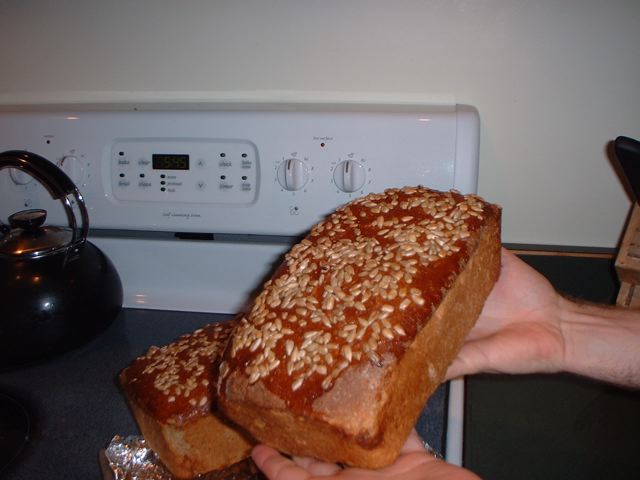
My hyper-mediating colleague Marshall wanted me to blog about the 5k "Run Through State U" on Saturday (in case you want to know, it was pretty uneventful, outside of the fact that the nice young woman who toured me around campus during my on-campus interview came up and re-introduced herself).
No dice, Marshall. Today I clear the deck to bring you these beautiful LOAVES O' LOVE. The recipe for these multi-multi grain loaves came from one of Sport's former colleagues (appropriately enough, a medievalist). They have cracked wheat, sunflower seeds, sesame seeds, all purpose flour, whole wheat flour (North Dakota stone ground, incidentally), wheat germ, yeast, a little shortening, water, honey, and molasses. Oh, and we used an egg and milk wash with sesame seeds on the outside. We've already had some of the bread with some local honey. Low carb is for the insane, my friends.
Subscribe to:
Posts (Atom)